Your next client asks an AI which law firm to use, long before they contact one.
People with a legal problem now describe it to ChatGPT, Gemini, Perplexity or Google’s AI results first. They ask what their options are, which firms handle that kind of work, and what those firms’ reputations look like. By the time an enquiry arrives, a shortlist has already been made. High 5 Guru helps UK law firms become visible, correctly understood and credibly evidenced inside those answers – so your firm is one of the few names that appears.
- ChatGPT
- Google AI Overviews
- Gemini
- Perplexity
- Google Search
- Measured, not guessed
- Built around your practice areas
- No guarantees, no invented claims
Optional supporting service: once the enquiries increase, we can also build custom AI workflows that organise and draft responses to them – with human approval retained.

The client asks an AI assistant first. Your firm is judged before the phone rings.
Legal work has always started with a private worry and a search. What has changed is where that search happens. Instead of scrolling ten blue links, prospective clients now hold a conversation with an AI assistant – and that conversation covers the advice, the shortlist and the reputation check in one sitting.
-
They ask the AI for advice, not for a website
“My employer has changed my contract without asking me. What are my rights?” The assistant explains the position in plain English and tells them what kind of solicitor they need. Your firm is not involved in this step – but the language, framing and definitions the client now carries forward are.
-
They ask which firms to use
“Which law firms handle employment disputes in Manchester?” The answer is a short list of names, often with a sentence of justification for each. Firms that are not named at this moment are not rejected – they are simply never considered.
-
They check the reputation of the firms named
“What do people say about this firm? Are their solicitors any good?” Reviews, directory profiles, solicitor credentials, published articles, press mentions and regulatory records are pulled together into a summary the client reads in seconds. Thin, inconsistent or contradictory evidence is visible immediately – and so is a firm with none at all.
-
Only then do they make contact
By the time an enquiry form is completed or a phone rings, the client has usually narrowed the field to one to three firms and already believes something specific about each of them. The competition happened earlier, inside an answer your firm never saw.

Why an AI assistant names one firm and not another
An AI assistant does not rank law firms the way a search engine ranks pages. It assembles an answer from what it can identify, retrieve and verify about each firm. Being named requires all three: the system must know your firm exists as a distinct entity, be able to retrieve content that answers the question, and find independent evidence that supports what your firm claims about itself. Miss one layer and the firm quietly drops out of the answer.
This is broader than rankings or backlinks. Backlinks create paths; entity authority creates recognition. We work across three layers, and the audit tells you which of them is currently letting your firm down:
Entity understanding
Can AI systems clearly identify the firm, its people, services and locations – and keep those facts consistent everywhere they appear?
Retrieval readiness
Can the firm’s content be found, interpreted and used in relevant answers – clear service pages, structured data and well-organised information?
Authority and evidence
Do credible third-party sources, reviews, citations, directories and consistent facts support the firm’s claims about its expertise?

The questions clients ask an AI assistant before they ask you
These fall into three groups, and prospective clients move through them in order: questions seeking advice, questions asking which firms to use, and questions checking whether those firms can be trusted. The commercial question for your firm is simple: when these prompts are asked, does the available evidence point to you?

1. Advice-seeking – the client is diagnosing the problem
2. Shortlisting – the client is asking which firms to use
3. Reputation checking – the client is verifying the shortlist
These are example research prompts illustrating how prospective clients use AI tools – not current rankings, and not a promise of inclusion in any AI answer. Your audit benchmarks the specific prompts that matter to your practice areas and offices, and records what each platform currently says.
The Law Firm AI Visibility Audit: measure first, recommend second
Everything starts with evidence. The audit establishes where your firm currently appears, what AI systems understand about it, and which improvements are most commercially valuable. We review:

- Important client search questions
- Current AI mentions and citations
- Practice-area visibility
- Geographic visibility
- Brand and entity consistency
- Website structure
- Service-page clarity
- Author and solicitor profiles
- Structured data
- Reviews and reputation signals
- Legal directories
- Digital PR and third-party references
- Content gaps
- Technical accessibility
- Internal linking
- Competitor visibility
- Measurement and reporting
Find out what AI systems currently say – and don’t say – about your firm.
The audit benchmarks your visibility across commercially valuable legal prompts and shows exactly where to improve.
Generative engine optimisation for solicitors, done properly
No agency can guarantee what an AI platform recommends – and you should be wary of any that claims otherwise. What we can do is strengthen every signal those systems rely on, and measure the result.

AI visibility benchmarking
Measure whether and how the firm appears for important prompts across AI platforms – your baseline before any work begins.
Legal prompt and demand research
Identify the questions prospective clients actually ask during research and selection – mapped to your practice areas and locations.
Entity optimisation
Strengthen the relationship between the law firm, its solicitors, services, offices and external references – so AI systems know exactly who you are.
AI-ready legal content
Create and improve useful, fact-based content that answer systems can understand and retrieve – clear, specific and genuinely helpful to clients.
Structured data and technical clarity
Improve schema markup, page structure, metadata and technical accessibility so machines can parse what your pages actually say.
Third-party authority
Develop legitimate citations, references, expert contributions, directory profiles and media opportunities – the evidence AI systems weigh.
Reviews and reputation signals
Improve the consistency and usefulness of verified client evidence across the platforms AI systems read.
AI visibility monitoring
Track mentions, citations, competitive movement and changes over time – so progress is measured, not assumed.
And when the enquiries start arriving
Visibility is the service. Everything from here is optional – a supporting workstream some firms add once AI visibility work starts producing more enquiries. Skip to booking the visibility audit if that is all you need today.
Being named by an AI assistant puts more people in front of your intake process. That is the objective – but it raises a practical question: what happens when those enquiries arrive? Firms handling more first contacts tend to need:
- Consistent intake, whoever picks up the email
- Fast routing to the right practice area
- Clear ownership of every new matter
- Proper follow-up when information is outstanding
- Human approval before anything external is sent
- Less administrative pressure on solicitors and staff

Optional: automate the admin behind the enquiries you win
This is a supporting service, not the main engagement. Most firms begin with AI visibility alone and add automation later, if at all.
For firms that want it, High 5 Guru builds custom AI workflows that support your team behind the scenes. Configured around your firm’s own rules – never a generic chatbot – a workflow can:
- Monitor approved enquiry channels and shared inboxes
- Classify matters and identify practice areas
- Extract key details, dates and requested actions
- Route enquiries to the correct solicitor or team
- Prepare structured internal summaries
- Draft acknowledgement emails from approved templates
- Request missing information or documents
- Create follow-up reminders automatically
- Escalate urgent or sensitive communications to a named person
- Require human approval before any external sending

- Enquiry received
- Matter type identified
- Key details extracted
- Correct team selected
- Response and task drafted
- Human review before sending
- Conveyancing
- Family law
- Immigration
- Commercial law
How much administrative capacity could your firm recover?
A busy firm may be able to recover a significant amount of administrative capacity – potentially reaching 100 hours per month in higher-volume environments. Actual results depend on enquiry volume, workflow complexity, integrations and approval requirements, and are estimated properly during the audit.
Estimate your firm’s recoverable admin time
Adjust the figures to match your firm. Defaults are illustrative starting points, not benchmarks.
Your estimate
These figures are estimates for discussion only – not guarantees or a quotation. They assume the automated portion of each enquiry’s administration is removed; actual results depend on your processes, systems, integrations and approval rules, and are assessed properly during the audit.

AI supports professional judgement – it does not replace it
Every workflow is designed around your firm’s approved processes, access rules and human-review requirements. Responsible adoption means the controls are designed in from the start, not added later:
- Mandatory human review before external or sensitive messages are sent
- Role-based permissions and restricted system access
- Data minimisation – the workflow touches only what it needs
- Approved templates, escalation rules and manual override
- Audit trails recording what was read, drafted, approved and sent
- Supplier due diligence and data-processing agreements where appropriate
- Testing with anonymised or synthetic data before live client data
- Retention settings, incident procedures and a DPIA where appropriate
How the work runs: visibility first, automation only if you want it
Every stage is labelled so you can see which parts build your firm’s AI visibility and which belong to the optional automation track. Stages 1 to 4 and 7 are the core visibility programme; stage 5 only happens if you choose to add automation. Nothing goes live without discovery and testing.

-
Visibility and workflow discovery Both
Understand your practice areas, locations, ideal clients, current marketing – and how enquiries currently flow through inboxes, people and systems.
-
Client-prompt and competitor research Visibility
Identify the commercially valuable questions prospective clients ask AI systems, and benchmark your visibility against competing firms for those prompts.
-
Entity, content and technical audit Visibility
Review entity consistency, service pages, solicitor profiles, structured data, directories, reviews, citations and technical accessibility.
-
AI visibility strategy Visibility
A prioritised, evidence-led plan: what to fix, create and strengthen first – mapped to the prompts and practice areas that matter commercially.
-
Automation opportunity assessment Automation
Estimate realistic time savings, identify sensitive data and regulatory considerations, and design the approval and escalation rules for any workflow.
-
Controlled implementation and testing Both
Publish content and entity improvements progressively; prototype automation with anonymised or synthetic data, test with staff, then launch gradually.
-
Monitoring and continuous improvement Both
Track AI mentions, citations and competitive movement; monitor workflow accuracy and time savings; refine both tracks using approved feedback.

Be named in the answer – and be ready for the client who acts on it
The primary outcome is visibility: your firm named, understood and credibly evidenced when a prospective client asks an AI which solicitors to use. If you also add the optional automation track, your team can respond consistently without losing the human judgement clients expect. Together, that means:
- More qualified prospects discovering the firm
- Greater clarity around the firm’s expertise
- Stronger supporting evidence across the web
- More consistent enquiry responses
- Less administrative pressure on the whole team
- More solicitor time available for clients and legal work
Razvan Calarasu, MBA – Founder, High 5 Guru
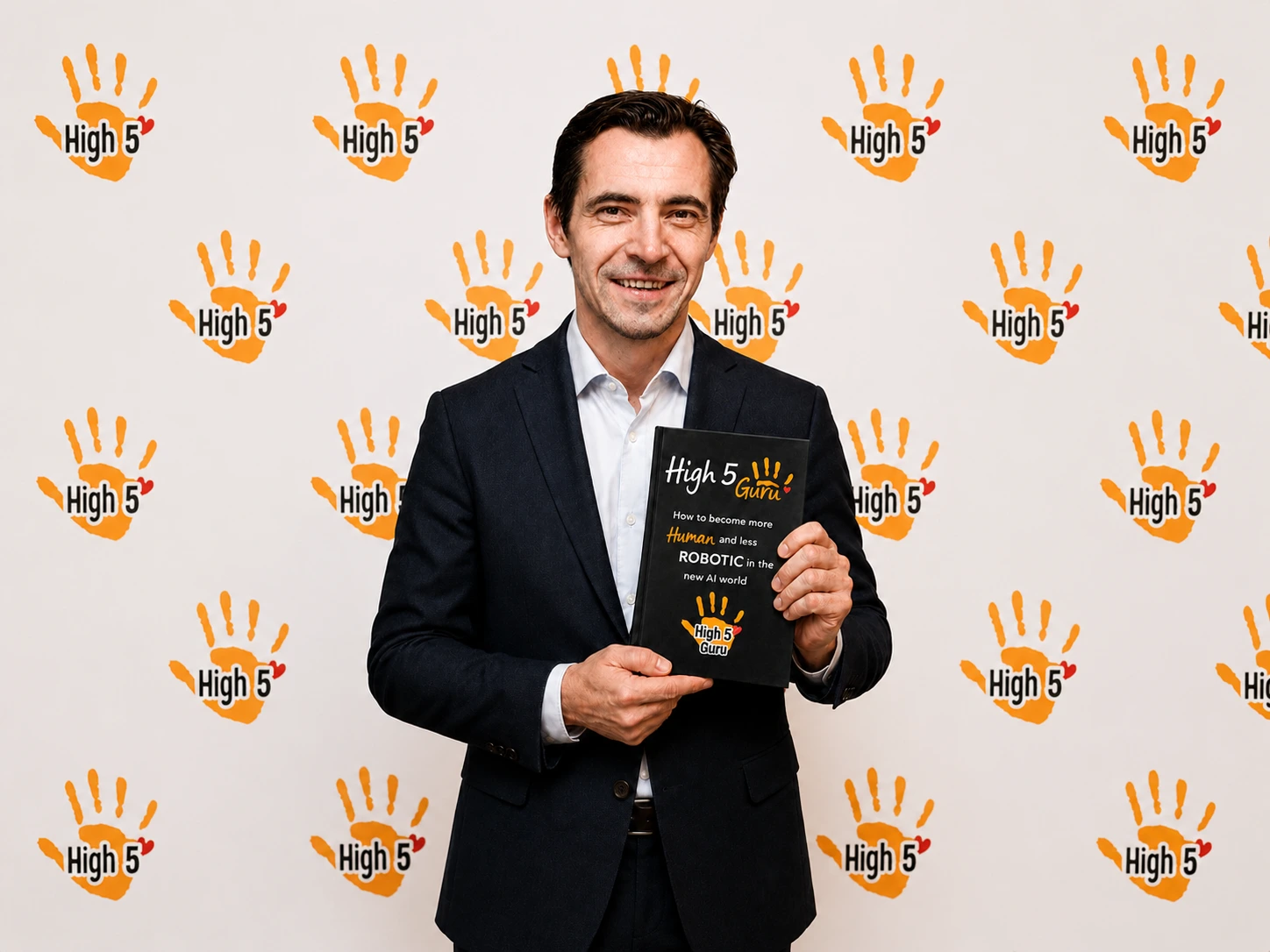
Razvan is an AI visibility strategist and founder of High 5 Guru, with 15 years in search and digital strategy. He works directly with founders and leadership teams in trust-based sectors – including legal services, healthcare and cybersecurity – helping brands appear in ChatGPT, Gemini and Google AI results, and turning AI into practical business outcomes.
- MBA
- 15 years in search & digital strategy
- UK based, working across the EU
- Focus sectors: legal, healthcare, cybersecurity & IT
His approach for regulated sectors is deliberately conservative: measure first, strengthen the evidence, and keep humans in control of every sensitive step. As he puts it, “people will always choose people” – visibility and automation exist to give your people more time to be exactly that.
Razvan is also the author of the book High 5 Guru: How to Be More Human and Less Robotic in the New AI World (out now on Kindle), on keeping brands and professional relationships human as AI reshapes how clients find and choose firms.
Hussain Solicitors: search and AI visibility for a Birmingham criminal defence firm
Hussain Solicitors is a specialist criminal defence firm based on Coventry Road in Small Heath, Birmingham. People who need a criminal defence solicitor usually need one quickly, and many now start by asking Google or an AI assistant who to call. High 5 Guru worked with the firm on how it is found, described and evidenced in those results.
What the work covered
Local SEO and Google Business Profile
The firm’s Google Business Profile and its presence in local search results for Birmingham and the West Midlands.
Technical and content SEO
The technical foundations of the firm’s website and the content of its practice-area pages.
AI visibility (GEO)
How clearly AI assistants such as ChatGPT, Gemini and Google’s AI results can identify the firm, its solicitors and the work it does.
Results while we worked together
- 1,240 calls Calls to the firm from January to September 2026.
- Position 1 The firm reached the top position in the Google map pack over the same period.
The firm on the public record
- Band 1 The firm’s practice head is ranked Band 1 for Crime in the West Midlands by Chambers UK 2026.
- Legal 500 Ranked by The Legal 500 for general crime and fraud in the West Midlands.
- 4.6 out of 5 Google rating from 220 client reviews, as shown on Google in October 2026.
These rankings and reviews are the firm’s own achievements, earned through its legal work. They are shown for context, not as results of our work. They are examples of the independent evidence that search engines and AI assistants draw on when they describe a law firm.
Read our guide: How UK solicitors get recommended by AI search in 2026.
Request a Law Firm AI Visibility and Automation Audit
Tell us about your firm, its priorities and its biggest bottleneck. We review your answers before the call, so the conversation starts with your firm’s visibility and workflows – not a sales pitch.
Your details are used only to respond to your enquiry and prepare your audit. They are never sold or shared for marketing. Read our privacy policy.
Frequently asked questions
What is AI visibility for a law firm?
AI visibility is the ability of AI-powered systems – such as ChatGPT, Gemini, Perplexity and Google’s AI results – to correctly identify your firm, understand its services, associate it with relevant practice areas and locations, retrieve its content for appropriate questions, reference credible evidence about it, and recommend it when the available evidence supports that recommendation.
Do prospective clients really use ChatGPT to choose a law firm?
AI assistants are now a common first step for people with a legal problem. A typical sequence is: describe the problem and ask what the options are, ask which firms handle that kind of work, then ask what those firms’ reputations look like – reviews, solicitor credentials, directory profiles and published articles – before contacting one to three shortlisted firms.
Adoption varies by demographic and matter type, so we measure what is actually happening for your practice areas rather than quoting a headline statistic. That measurement is the first part of the audit.
How is AI visibility different from traditional SEO?
Traditional SEO focuses on ranking pages in search results. AI visibility is broader: it concerns whether AI systems can understand the firm as an entity, retrieve and use its content in generated answers, and find consistent third-party evidence supporting its expertise. The two complement each other, but AI visibility requires additional work on entities, structured data, content clarity and external citations.
Can you guarantee that an AI platform will recommend our firm?
No, and no consultancy can. AI platforms generate answers from their own models and evidence, and nobody controls their outputs. What can be done is to measure your current visibility, strengthen your entity signals, content and third-party evidence, and increase the likelihood of being retrieved and referenced for relevant questions. Progress is measured openly so you can see the movement.
Which legal search questions should we target?
That is established through legal prompt and demand research: identifying the commercially valuable questions prospective clients ask during research and selection, mapped to your practice areas, locations and client types. The audit then benchmarks your firm’s current presence for those prompts.
How do you measure AI visibility?
By benchmarking a defined set of commercially relevant prompts across AI platforms, recording whether and how your firm is mentioned or cited, tracking competitor visibility for the same prompts, and repeating the measurement over time to show movement.
Does our law firm need new content?
Not necessarily. The audit identifies whether the priority is improving existing pages, adding structured data, clarifying service and profile pages, or filling genuine content gaps. Recommendations are evidence-led rather than volume-led – more content is not automatically better content.
Can you improve the visibility of individual solicitors?
Yes. Solicitor and author profiles are part of entity optimisation – clarifying each solicitor’s expertise, credentials, memberships and published work so AI systems can associate the right people with the right practice areas. This also strengthens the firm’s overall authority signals.
Can you help with local and practice-area visibility?
Yes. Visibility work is mapped to specific practice areas and office locations, so the firm becomes associated with the services it offers in the places it serves – for example conveyancing in a specific city, or business immigration nationally.
What does the automation system do?
A custom AI workflow can monitor approved enquiry channels, classify matters, identify practice areas, extract key details, route enquiries to the correct team, prepare internal summaries, draft acknowledgement emails, request missing information, create follow-up reminders and escalate urgent communications – with human approval required before external sending.
Will AI send client emails without approval?
Not unless your firm chooses that. Workflows are typically designed so that external or sensitive messages are drafted by the assistant and released only after a named person approves them. Internal routing and labelling can run automatically where your firm is comfortable with it. The approval boundaries are yours to set.
How is confidential information protected?
Every automation project starts with a workflow and data-risk review covering confidentiality, legal professional privilege, UK GDPR considerations, data minimisation, access controls, where data is processed and stored, logging and supplier due diligence. Testing uses synthetic or anonymised information before any live client data is involved, and final governance decisions remain with your firm and its advisers.
Can the system connect with Outlook or our case-management software?
Workflows are commonly designed around Microsoft 365 (Outlook) and Google Workspace (Gmail). Where your case-management or CRM system offers supported integration methods (such as an API), integration is assessed during the audit. If direct integration is not practical, structured summaries and tasks can still be delivered in other approved ways.
Will AI replace our administrative staff?
The systems are designed to remove repetitive email handling, not people. In practice, firms redirect recovered time towards client service, case progression, billing accuracy and reducing backlogs. Your team stays in control of every workflow.
How long does implementation take?
Visibility work typically begins producing improvements over a period of months as content, entity and authority signals strengthen. Automation projects move through discovery, risk assessment, prototyping with sample data, staff testing and a controlled launch. Timescales depend on scope and are confirmed after the audit.
Can we begin with an audit only?
Yes. The Law Firm AI Visibility and Automation Audit is a standalone piece of work with its own findings and recommendations. Many firms use it to decide internally what to prioritise. There is no obligation to continue beyond it.
Does High 5 Guru provide legal advice?
No. High 5 Guru provides technology and marketing consultancy, not legal advice. Each law firm remains responsible for its regulatory, professional, confidentiality and data-protection obligations, and its systems are designed to support – never replace – the professional judgement of its solicitors.
Be the firm the AI names
The audit shows where your firm stands in AI answers today, what to strengthen first, and how much administrative capacity your team could realistically recover. If the timing isn’t right, the audit will tell you that too.
High 5 Guru · info@high5guru.com · +44 20 8150 4242 · www.high5guru.com