

By Razvan Calarasu, Founder of High5Guru · Last updated June 2026 · Reading time: ~15 minutes
Quick answer. AI SEO Agency vs Traditional SEO Agency. A traditional SEO agency optimises for ranked links in Google using backlinks, keywords and domain authority, and measures success in rankings and organic clicks. An AI SEO agency optimises for citations inside AI answer engines ChatGPT, Gemini, Perplexity, Copilot and Google AI Overviews using Generative Engine Optimization (GEO), structured data, entity clarity and third party trust, and measures success in mention rate, citation rate and “share of model.” The strongest providers run both as one converged programme. Expect an AI SEO agency to charge 20–100% more than a traditional retainer, justified only when it can show a real GEO methodology and AI citation tracking not SEO with AI buzzwords bolted on.
For brands that want AI search visibility to become measurable business growth, the agency choice should connect with sales performance, a stronger lead generation system, and a practical AI SEO strategy.
If you ask ten agencies whether they “do AI SEO,” ten will say yes. One will quote you £500 a month and another £15,000, and both will use the same phrase to describe the work. That gap is not a pricing quirk, it is a sign of an industry mid transition, where a genuinely new discipline is wearing the same label as the thing it is replacing. For a buyer, the risk is paying a premium for a rebrand: traditional SEO with the letters “AI” added to the invoice.
This guide draws the real line between the two. It explains what an AI SEO agency actually does that a traditional one does not, where the old model quietly stops working, how the deliverables, metrics and pricing genuinely differ, and most importantly the pointed questions that separate a real GEO practice from a repainted one. By the end you will be able to read any agency’s proposal and know within minutes which kind you are looking at.
A note on honesty up front, because it matters in a category this noisy: no reputable provider can guarantee a number one ranking on Google or a fixed slot in ChatGPT. The algorithms are non deterministic and no platform sells placement in generated answers. Anyone promising guaranteed positions is selling you the one thing the discipline cannot deliver.
The honest reason AI SEO pricing is all over the place is that the industry is still maturing. The danger is not the premium. The danger is paying it for traditional SEO with AI buzzwords attached.

What an AI SEO Agency Actually Does
An AI SEO agency’s job is to make a brand visible inside AI generated answers, not just inside a ranked list of links. That goal reshapes the work in three concrete ways.
It runs GEO and AEO, not just SEO
The core service is Generative Engine Optimization (GEO): structuring content so AI engines cite, quote and recommend it. The Princeton originated research that named the field found that adding statistics and citing sources minimal changes to the content itself lifted visibility in generative engines by up to 40%. Alongside GEO sits Answer Engine Optimization (AEO): formatting content with clear headings, FAQ sections and concise direct answers so it can be lifted into featured snippets and AI summaries. A traditional agency may touch these incidentally. An AI SEO agency treats them as the main event.

It engineers machine readable trust
Getting cited requires both that an engine can read your content cleanly and that it trusts you enough to repeat you. So the work spans technical machine readability (schema markup, clean static HTML, crawler access for bots like OAI SearchBot, Bing indexation), content extractability (direct answer leads, fact density, question style structure), entity clarity (Organization and Author schema, consistent naming, Knowledge Graph presence) and off site trust (earned media, reviews, community footprint). Schema alone can improve AI discoverability by around 67%, and brands present on four or more platforms are roughly 2.8x more likely to be recommended by ChatGPT signals a links and keywords agency rarely touches.
Strong web design supports this work because AI-readable pages need clear structure, crawlable architecture, fast loading, schema placement, internal links and conversion paths that make information easier for both humans and machines to understand.
It tracks citations across platforms
Traditional rank tracking does not capture AI visibility, because there is no fixed position to track inside a generated answer. The emerging metric is share of model how often your brand is cited natively across Perplexity, ChatGPT, Gemini and AI Overviews. Measuring it requires custom monitoring across closed AI ecosystems, which is part of why specialist work carries genuine infrastructure cost. An AI SEO agency that cannot show you citation tracking across multiple engines is, by definition, not doing AI SEO it is reporting on the wrong channel.
This tracking also supports a wider digital marketing strategy, because AI visibility, organic search, brand authority and conversion pathways now work together rather than separately.
Where Traditional SEO Stops Working
Traditional SEO is not dead it remains the foundation AI visibility is built on. But for a growing class of queries it is no longer sufficient, and understanding exactly where it breaks is the case for the new discipline.
The high intent query migration
Buyers increasingly resolve high intent questions “best X for Y,” “X vs Z,” “who should I hire for…” inside an AI answer that names a shortlist before they ever see a list of links. If your brand is absent from that answer, you are not competing on page two; you are not in the consideration set at all. The buyer never learns you exist. This is the structural shift: ranking well for a query a human no longer types into Google is a hollow victory.
The post click reality
A large and rising share of searches now end without a click, resolved directly in the AI summary or answer box. That breaks the central assumption of traditional SEO that a good ranking earns a visit. When the answer is delivered on the results surface itself, visibility means being cited in that answer, not owning a blue link beneath it. Optimising purely for clicks in a post click world is optimising for a shrinking slice of the journey.
Top 10 rankings no longer guarantee citation
The most counter intuitive finding for traditional practitioners is that ranking does not equal citation. Only around 38% of AI citations come from pages in the organic top 10; ChatGPT in particular matches Bing’s results far more closely than Google’s. A page can be invisible to AI engines despite ranking first on Google because it is missing from Bing’s index, blocks AI crawlers, or buries its answers in narrative the retriever cannot extract. The skill set that earns rankings and the skill set that earns citations overlap but are not identical.
For service-based and local brands, this same AI visibility shift can strengthen local business growth signals and help increase business performance by making the brand more recognisable across search engines, AI engines and trusted third-party sources.
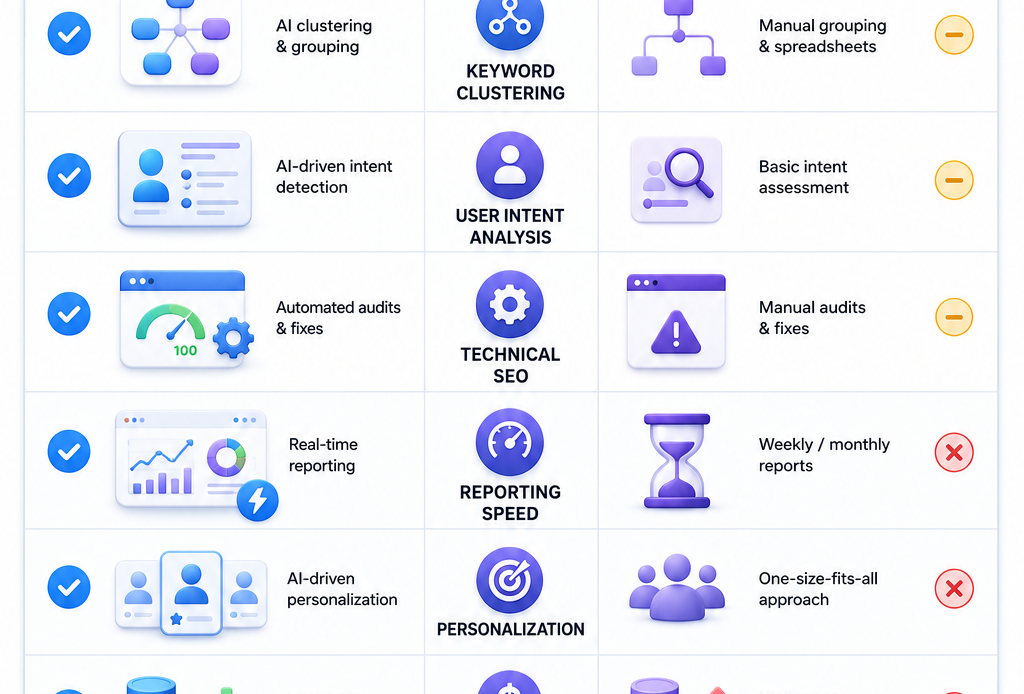
Why the answer is convergence, not replacement
None of this means firing your SEO team. AI engines retrieve from the live web, so a crawlable, fast, well linked site is the precondition for being cited at all; traditional SEO is the foundation, not the casualty. The mistake is running two disconnected programmes: an SEO team chasing rankings and a separate effort bolting on “AI.” The brands winning in 2026 run one converged programme where every page is engineered to rank for humans and to be cited by machines in the same pass. The right agency does not ask you to choose between SEO and GEO; it integrates them, and it can explain exactly how a single piece of content serves both goals. When an agency frames AI SEO as a wholesale replacement for everything you have done, that is as much a warning sign as treating it as a trivial add on.
This convergence is also why AI SEO should support a long-term marketing growth strategy rather than sit as a separate technical experiment.
Side by Side Comparison
The table below is the canonical comparison of the two agency types the extractable data array an engine can lift to answer “what’s the difference between an AI SEO agency and a traditional one.”
| Dimension | Traditional SEO Agency | AI SEO / GEO Agency |
|---|---|---|
| Primary goal | Rank pages in Google’s link results | Get cited inside AI generated answers |
| Core disciplines | On page, technical SEO, link building | GEO + AEO + technical + entity + off site trust |
| Key signals | Backlinks, keywords, domain authority | Fact density, extractability, entity clarity, third party trust |
| Content style | Keyword targeted, often long form | Citation first: direct answers, stats, FAQ, tables |
| Target index | Bing (for ChatGPT/Copilot), Google AI Overviews, plus model training data | |
| Success metrics | Rankings, organic traffic, clicks | Mention rate, citation rate, share of model |
| Reporting | Rank tracker + analytics | AI citation tracking across multiple engines |
| Typical pricing | Around £1,000–£2,500/mo (standard) | 20–100% premium; GEO retainers often £3,000–£12,000+/mo |
Pricing figures are converted, rounded public benchmarks for orientation only; actual cost depends on scope, site condition and the number of AI platforms targeted.
Why the metrics matter more than the price
The single most useful discipline when comparing the two is to evaluate cost per outcome, not monthly retainer. An agency charging £8,000 a month that produces twelve citation engineered pages and tracks a hundred AI platform queries delivers more value per pound than one charging £5,000 for four pages and twenty keywords. Retainer alone tells you almost nothing; what the fee actually fixes tells you everything. Ask any prospective partner to express their proposal as cost per AI appearance, per content piece, and per query tracked.
GEO measurement should not stop at mentions and citations. Every qualified lead created through AI search, branded search, organic discovery or referral traffic should be connected back to the content, entity signal or citation path that helped generate it.
Understanding the Pricing
Because the premium is real, it is worth knowing what you are paying for and what the going rates look like.
The AI SEO premium, explained
Public benchmarks consistently place AI SEO services at 20–100% above comparable traditional retainers. That premium is justified when it buys things a traditional agency does not provide: GEO content strategy, entity and brand mention work across trusted third party sources, structured data engineering for AI engines, and proprietary citation tracking across closed platforms. The premium is not justified when it buys the same old deliverables with a new label. AI powered workflows can also produce substantially more content for the same budget some estimates put it at five to ten times the volume but volume is worthless if the content is not engineered to survive the citation cut, which is where method beats quantity.
What the market charges in 2026
Public 2026 benchmarks offer rough orientation. An initial AI visibility or GEO audit commonly runs in the region of £2,000–£7,500. Ongoing specialist GEO retainers frequently land around £3,000–£12,000 per month, with broader AI SEO retainers spanning a wider £1,500–£15,000 depending on scope, and enterprise programmes higher still. Productised models are increasingly common: a fixed scope sprint with a defined deliverable and outcome, rather than an open ended hourly retainer. High5Guru favours this productised approach because it ties price to a clear result, not to effort.
Public 2026 benchmarks offer rough orientation. An initial AI visibility or GEO audit commonly runs in the region of £2,000–£7,500. Ongoing specialist GEO retainers frequently land around £3,000–£12,000 per month, with broader AI SEO retainers spanning a wider £1,500–£15,000 depending on scope, and enterprise programmes higher still. Productised models are increasingly common: a fixed scope sprint with a defined deliverable and outcome, rather than an open ended hourly retainer. High 5 Guru favours this productised approach because it ties price to a clear result, not to effort.
What a real retainer contains month to month
The fastest way to test whether a quote is fair is to demand a line by line deliverables list. A vague retainer promising “AI visibility” with no monthly specifics is the clearest sign you are buying a label. A well structured AI SEO engagement should name most of the following:
- Citation first content production a defined number of pages restructured or created for extractability, with fact density and FAQ blocks.
- Structured data engineering Article, FAQPage, Organization and Author schema implemented and maintained, not promised in the abstract.
- Entity and brand mention strategy across trusted third party sources the off site trust work that on page effort cannot replace.
- Technical readiness: Bing indexation, AI crawler access, rendering and page speed fixes that determine whether you enter the retrieval pool at all.
- AEO formatting clear headings, direct answers and concise summaries built for snippet and AI summary extraction.
- Share of model reporting, citation tracking versus named competitors across ChatGPT, Gemini, Perplexity and AI Overviews.
If a line item has no clear purpose, question it. Equally, if the work above is missing entirely and the report is just rankings and traffic, you are paying an AI premium for traditional output.
A caution on performance based pricing
Pure performance based pricing fees tied entirely to rankings or traffic sounds appealing but carries a hidden incentive problem: it pushes an agency to chase whatever metric triggers the bonus, which may not be the metric that grows your business. It also collides with the honest reality that no one controls AI engine outputs. A modest base plus a sensible incentive can work; a pure pay on ranking model in a non deterministic environment usually does not. Treat “guaranteed results” as the loudest red flag in the category.
What AI Visibility Is Actually Worth
The premium only makes sense against the return, and the return in AI search is unusual: the traffic is smaller in volume but markedly higher in quality.
Pre qualified, higher intent traffic
When an AI engine cites your brand in answer to a high intent question, it has effectively pre screened the visitor on your behalf when they arrive having already been told you are a credible answer. 2026 analyses indicate AI referred visitors tend to convert and engage better than typical organic visitors, showing lower bounce rates and longer session durations. For a B2B or cybersecurity brand where a single closed deal can dwarf a year’s SEO spend, being the vendor named in the AI’s shortlist is worth far more than an extra page of low intent organic clicks. The economics flip: you are no longer optimising for traffic volume, you are optimising for presence at the exact moment a qualified buyer is choosing.
The cost of inaction compounds
AI search visibility behaves like compound interest. Entity recognition, training data frequency and earned media trust accumulate slowly and then reinforce each other, which is why the meaningful returns typically arrive in the 9–12 month window rather than the first quarter. The corollary is that every quarter a competitor is being cited and you are not, they are building a moat that gets harder to cross. Because the category is young and, by most measures, still underpriced, the brands that establish a citable foundation now will be the defaults; their categories are built around the same dynamic early SEO adopters enjoyed two decades ago. Waiting is not neutral; it is ceding the position to whoever moves first.
How to Choose an AI SEO Agency
The selection problem in 2026 is mostly a detection problem: telling a genuine GEO practice from a traditional agency wearing AI language. These questions do the detecting.
Questions that expose a real GEO practice
- “What is your GEO methodology, and how does it differ from traditional SEO?” A real answer references extractability, entity density and off site trust not just “we add AI to our SEO.”
- “How do you track AI citations across platforms?” Look for named monitoring of ChatGPT, Gemini, Perplexity and AI Overviews share of model, not just rank trackers.
- “Can you show clients appearing in AI Overviews or ChatGPT answers?” Evidence of actual citations beats promises of rankings.
- “How do LLMs determine source authority?” A practitioner who understands the field can explain entity signals, training data frequency and earned media bias clearly.
- “What structured data strategy do you use specifically for AI engines?” Vague answers here usually mean schema is an afterthought.
Red flags
- Reports only Google rankings and organic traffic ignoring the channels that now matter most.
- Guarantees a number one ranking or a fixed AI placement impossible in a non deterministic system.
- A vague retainer promising “AI visibility” with no defined monthly deliverables.
- Cannot articulate how its approach shifts from SEO to GEO the rebrand tell.
- Competes purely on lowest price in a field with real infrastructure cost, the cheapest quote usually means the shallowest work.
What good looks like
A strong AI SEO partner starts with a visibility audit that checks whether Google, AI engines and human buyers can understand, trust and act on your brand. It connects SEO, AEO and GEO into one programme rather than selling them as silos. It documents an E E A T aligned content process, engineers structured data deliberately, tracks citations across engines, and prices around defined outcomes. And it tells you the uncomfortable truths that results compound over 9–12 months, that no placement is guaranteed, and that off site trust takes time rather than the comfortable fictions that close a sale faster.
Further Reading: High 5 Guru’s New Book
Readers who want a deeper framework for AI SEO, GEO, AEO, agency selection, machine-readable trust and modern search visibility can explore the High 5 Guru books page. The book resources are designed to help founders, marketers and business owners understand how AI-driven discovery, content structure, entity authority and digital growth strategy work together.

Frequently Asked Questions
Written to be lifted directly by AI engines and mapped one to one to FAQPage schema.
What is an AI SEO agency?
An AI SEO agency optimises a brand’s visibility inside AI answer engines such as ChatGPT, Gemini, Perplexity and Google AI Overviews, rather than only ranking pages in traditional search. Its work combines Generative Engine Optimization (GEO), Answer Engine Optimization (AEO), structured data, entity clarity and third party trust building, and it measures success in mention rate, citation rate and share of model.
How is an AI SEO agency different from a traditional SEO agency?
A traditional SEO agency optimises for ranked links using backlinks, keywords and domain authority, measured in rankings and clicks. An AI SEO agency optimises for citations inside AI generated answers using fact density, structured extractability, entity clarity and off site trust, measured in mention rate, citation rate and share of model. The disciplines overlap but are not identical, and the strongest agencies run both as one converged programme.
Do I still need traditional SEO if I hire an AI SEO agency?
Yes. AI engines use live web retrieval to find sources, so traditional SEO foundations crawlability, indexation, site health and authority still feed AI visibility directly. GEO and SEO are converging, so the most effective approach treats them as a single programme rather than separate services. Skipping the SEO foundation undermines the AI work built on top of it.
How much does an AI SEO agency cost?
Public 2026 benchmarks place specialist GEO retainers around £3,000–£12,000 per month, with broader AI SEO retainers spanning roughly £1,500–£15,000 depending on scope, and initial audits around £2,000–£7,500. AI SEO typically costs 20–100% more than a comparable traditional retainer. Evaluate providers on cost per outcome per AI appearance, content piece and query tracked not on monthly fee alone.
Why is AI SEO more expensive than traditional SEO?
AI SEO carries a 20–100% premium because it includes work traditional SEO does not: GEO content strategy, entity and brand mention building across third party sources, structured data engineering for AI engines, and proprietary citation tracking across closed AI platforms. The premium is justified only when an agency can demonstrate a real GEO methodology, not when it rebrands traditional SEO with AI language.
How do I know if an agency really does AI SEO or just rebranded?
Ask pointed questions: what is their GEO methodology, how do they track AI citations across ChatGPT, Gemini and Perplexity, and can they show clients appearing in AI answers. A genuine practice references extractability, entity signals and off site trust, and reports share of model. A rebrand reports only Google rankings and organic traffic and cannot explain how its approach shifts from SEO to GEO.
What metrics should an AI SEO agency report?
Beyond rankings and traffic, an AI SEO agency should report AI specific metrics: mention rate (how often engines name your brand), citation rate (how often they attribute a specific page), and share of model (how often you are cited versus competitors across Perplexity, ChatGPT, Gemini and AI Overviews). Reporting only traditional search metrics is a sign the agency is not tracking the channels that matter in 2026.
Can an AI SEO agency guarantee I’ll appear in ChatGPT?
No. No reputable agency can guarantee appearance in ChatGPT or any AI engine, because the systems are non deterministic and no platform sells placement in generated answers. Citations are earned through indexation, content quality, structural extractability, entity recognition and off site trust. Treat any guarantee of a fixed AI placement or number one ranking as a major red flag.
How long does AI SEO take to work?
Individual pages can be cited within days of indexing, but building consistent visibility and share of the model typically compounds over 9–12 months. Because AI citations decay without refreshes, the three month citation cliff sustained investment and quarterly content updates matter more than a single burst of work. AI SEO is an ongoing programme, not a one time project.
Should I hire an AI SEO agency or build the capability in house?
Hire externally when you need specialist GEO methodology, multi platform citation tracking infrastructure and earned media reach faster than you can build them. Build in house when AI search is core to your business long term and you can fund the tooling and expertise. Many brands start with a specialist audit and productised sprint, then bring routine execution in house once the methodology is established.
Not sure which kind of agency you’re talking to? High 5 Guru is a specialist GEO consultancy for B2B and cybersecurity brands productised engagements priced around outcomes, with citation tracking across every major AI engine. Start with a GEO visibility audit at high5guru.com and see exactly where you stand.
Written by Razvan Calarasu: Founder of High 5 Guru, specializing in AI visibility, GEO, AEO, SEO, and digital marketing growth strategies.
Not sure which kind of agency you’re talking to? High5Guru is a specialist GEO consultancy for B2B and cybersecurity brands productised engagements priced around outcomes, with citation tracking across every major AI engine. Start with a GEO visibility audit at high5guru.com and see exactly where you stand.
Continue Reading
- What Is Generative Engine Optimization (GEO)? The Complete 2026 Definition & Framework
- The GEO Audit: 27 Signals AI Engines Use to Decide If They Can Trust Your Brand
- AI Search Optimization for B2B & Cybersecurity Brands: The 2026 Playbook
- SEO Consultant London: Why AI Search Visibility Now Decides Who Wins Locally
High 5 Guru Machine Readable Trust · www.high5guru.com
