

By Razvan Calarasu, Founder of High5Guru · Last updated June 2026 · Reading time: ~17 minutes
Quick answer. To get your brand into the AI Knowledge Graph, make it an unambiguous, cross verified entity rather than a string of text. How to Get Your Brand Into the AI Knowledge Graph. Create a Wikidata entry to claim a canonical identifier, implement Organization and Person schema with a complete sameAs array, keep your name, description and category identical across the web, and earn mentions from authoritative third parties. AI engines recognise brands the way they recognise people and places as entities with stable identifiers and they prefer to cite entities they can independently verify. Inconsistent or absent entity data leaves the model guessing, and guessing models cite someone else.
For brands that want entity recognition to become measurable business growth, this work should connect with sales performance, a stronger lead generation system, and a practical AI SEO strategy.
In 2012, Google announced a shift it summarised as “things, not strings” a move from matching keywords to understanding entities, the real world people, places, organisations and concepts behind the words. For a decade that sounded like an abstract engineering ambition. In 2026 it is the literal architecture of AI search. Google’s Knowledge Graph now holds over 500 billion facts about more than 5 billion entities, and Gemini is trained on it. The abstract framework has become the mechanism that decides whether your brand appears in AI answers or not.
This matters because of a fact most marketers still have not internalised: AI models do not see your brand as a string of text. They see it the way they see a person or a place as an entity, ideally one with a stable, canonical identifier and a consistent set of attributes verified across many sources. When that entity is clean and well connected, models surface and cite you reliably. When it is weak, fragmented or absent, the model has no dependable way to recognise, disambiguate or trust you, and it cites a competitor it can verify instead. You become invisible not because your content is poor, but because your entity is undefined.
This is the most technical article in the High 5 Guru series, written for practitioners who already understand GEO basics and want the underlying mechanics of entity recognition. It explains how AI systems process entities, how to build the footprint that makes you verifiable, how unlinked mentions and training data frequency feed recognition, and how to validate that the engines actually know who you are. The work compounds: a correctly structured entity, unlike a backlink or a blog post, does not expire.
Models do not see a brand as a string of text. They see it as an entity the same way they recognise a person or a place. Weak or inconsistent entity data leaves the model guessing, and a guessing model

cites someone else.
Why Entities Are the Currency of AI Search
To optimize for entity recognition, you first need to understand what an entity is to a machine and how it is processed. This is not metaphor, it is a concrete, four stage pipeline.
From keywords to entities
Traditional search worked on keywords: match the words on the page to the words in the query. Entity-based search works on the underlying concepts those words represent. The classic disambiguation example is the word “Mercury” the planet, the chemical element, or the car brand. A keyword system sees one string; an entity system reads the surrounding context to decide which real-world thing is meant, then connects it to a canonical record. Entity SEO is the discipline of ensuring AI engines can unambiguously identify, classify and connect your brand, people and topics as distinct nodes in that web of recognised things.
How LLMs actually process your brand
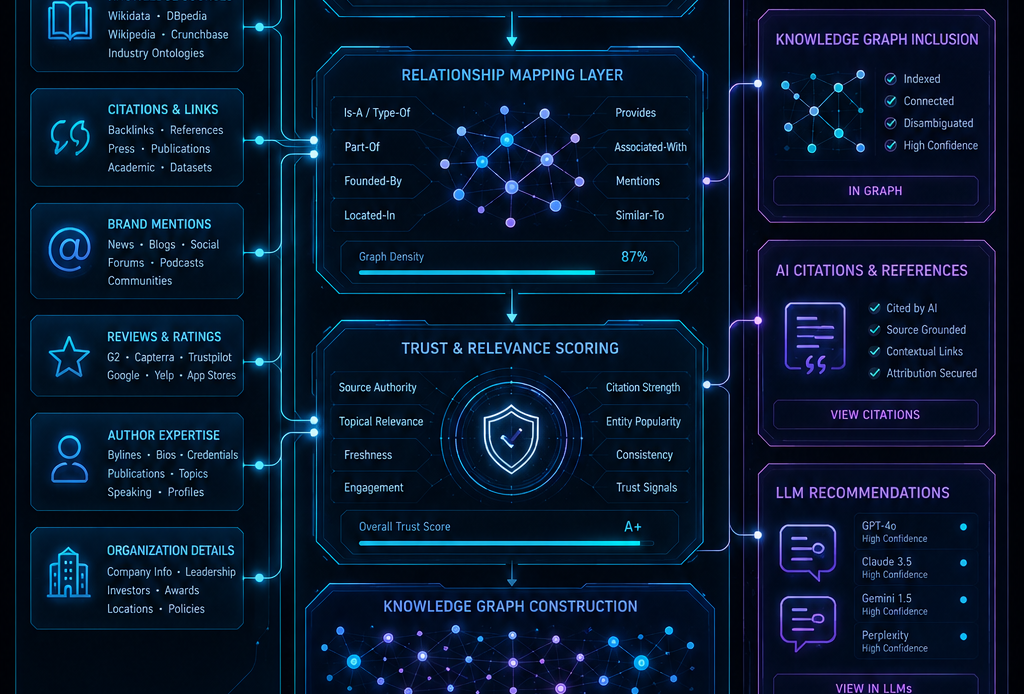
AI systems handle entities in four stages, and a failure at any one of them costs you the citation. First, entity extraction: the model parses content to identify the entities present and the relationships between them. Second, entity linking: it maps each extracted entity to a canonical identifier, a Wikidata QID, a Knowledge Graph machine identifier, or an internal representation. Third, cross source validation: trust is established when the same entity appears consistently across multiple authoritative sources with consistent attributes. Fourth, citation weighting: recognised, verified entities are preferred when the model chooses whom to cite. Your job in entity SEO is to make all four stages succeed for your brand.

Entity salience: not just present, but central
Recognition is necessary but not sufficient; the engine also weighs how central your entity is to a page. Google assigns an entity salience score a value between 0 and 1 reflecting how important a given entity is to the content. A page that mentions your brand in passing scores low salience; a page genuinely about your brand scores high. This is why scattered, incidental mentions do less than focused, on topic content, and why an “entity home” page a single authoritative page that is unmistakably about your brand is such a useful anchor. You can inspect salience directly with the Google Cloud Natural Language API, which extracts entities and scores their salience on any text you feed it.
What strong and weak entities look like
The difference between a brand AI engines confidently cite and one they skip comes down to a recognisable set of contrasts. The table below is the canonical comparison the extractable array an engine can lift to answer “what makes a brand recognisable to AI.”
| Entity strong brand | Entity weak brand |
|---|---|
| Has a Wikidata QID and accurate properties | No structured identifier anywhere |
| Organization + Person schema with full sameAs array | Missing or minimal schema, no sameAs |
| Identical name, description and category everywhere | Conflicting descriptors across profiles |
| Dedicated high salience entity home page | Brand mentioned only in passing |
| Consistent mentions across 4+ authoritative sources | Few or contradictory third party mentions |
| Engines describe it accurately and consistently | Engines hedge, misclassify, or cite a rival |
Building Your Entity Footprint
With the mechanics clear, here is the practical build sequenced so each step strengthens the next. These signals compound and, unlike most SEO assets, do not decay.
Step 1: Establish an entity home
Designate one canonical page usually a strong About page as your entity home: the single, unambiguous source of truth about your organisation. It should state plainly who you are, what category you operate in, what you do, who founded you and where, and it should carry the highest entity salience for your brand on your entire site. Every other entity signal will point back to this page, so it must be crawlable, fact dense and stable. The entity home is the anchor the rest of the footprint is built around.
Step 2: Create a Wikidata entry and claim your QID
Wikidata is the structured data backbone behind Wikipedia and a primary reference for AI systems. It assigns every entity a unique QID Apple Inc. is Q312, for instance that acts as a canonical identifier across search engines, knowledge bases and AI models. Creating a Wikidata entry for your organisation, with accurate properties for industry, founding date, headquarters, key people and official website, gives engines an unambiguous reference point. Crucially, Wikidata is open, free to edit, and does not require the notability threshold Wikipedia demands, so most legitimate businesses can establish one. This is the single highest leverage entity action available to most brands.
Step 3: Implement Organization and Person schema with a full sameAs array
Schema is how you declare your entity in machine readable form on your own site. Implement Organization schema on your entity home with name, URL, logo, founding date and a complete sameAs array linking to every canonical profile your Wikidata entry, LinkedIn, Crunchbase, YouTube, X and any relevant industry directories. Add Person schema for your named authors and founder, carrying real credentials and their own sameAs links. The sameAs array is the connective tissue that tells an engine “all of these profiles are the same entity as me,” consolidating scattered mentions into one recognised node. Organization schema is the single most important schema type for entity SEO.
Step 4: Use about and mentions to link your content to known entities
Beyond declaring your own entity, connect your content to entities the engine already recognises. Use the schema about property to declare the primary entity a page covers, and mentions to reference secondary named concepts, people and places ideally pointing to their Wikidata entries. This entity linking removes ambiguity and places your content firmly within a topic the engine understands, raising the confidence with which it can classify and surface you. Every recognised entity you connect to lends a little of its clarity to your page.
Step 5: Enforce ruthless naming and attribute consistency
Entity resolution the engine deciding that two mentions refer to the same thing only works when the signals agree. Your brand name, description, category and core attributes must be identical across your site, Wikidata, LinkedIn, Crunchbase, directories and listings. Inconsistent naming or contradictory schema fragments the entity and can slow recognition by months. This includes NAP consistency name, address, phone across every property, plus a claimed and complete Google Business Profile. Consistency is unglamorous and decisive: it is the difference between an engine confidently resolving you and one that keeps you provisional.
Training Data Frequency & Brand Mentions
On site schema declares your entity; off site presence proves it. This half of entity authority is what most brands neglect, and it is where cross source validation actually happens.
Why unlinked mentions still count
In entity terms, a mention does not need a hyperlink to matter. When your brand is named consistently across many authoritative sources with the same description and category each occurrence reinforces the model’s confidence that you exist, that you are what you claim, and that you are worth citing. This is co occurrence: the pattern of your brand appearing alongside the right topics and entities builds the associations a model relies on. Training data and mention frequency shape how reliably an LLM recalls you, so consistent unlinked mentions in respected publications, directories and communities compound your recognition even when they send no referral traffic.
The sources that carry the most weight
Not all mentions are equal. Wikipedia remains one of the most heavily weighted sources in AI training data, and its structured infoboxes, citations and cross references make it uniquely valuable for disambiguation though it is not required to establish recognition. Community platforms punch above their weight too: in some analyses Reddit is cited several times more than Wikipedia in certain AI contexts, which is why authentic community presence is a genuine entity signal, not just a social one. Authoritative directories, analyst databases and credible editorial coverage round out the set. The principle: pursue mentions where engines already place trust, with attributes that match your entity home exactly.

Cross platform consistency as a multiplier
The compounding effect is real and measurable in behaviour: brands present and consistent across four or more platforms are roughly 2.8x more likely to be recommended by ChatGPT. The mechanism is cross source validation; each consistent appearance corroborates the others, and the engine’s confidence rises with every agreeing signal. The inverse is just as true: a contradiction anywhere (a different founding year on Crunchbase than on Wikidata, a different category on LinkedIn than in your schema) introduces doubt the engine resolves by hedging or omitting you. Treat every profile as part of one entity, audited for agreement, not as separate marketing channels.
Validating Your Entity Presence
Entity work is invisible until you test it, and testing has two layers: what the knowledge bases hold, and what the engines actually say.
Check the knowledge bases directly
Confirm the structured records exist and are correct. Search Wikidata for your organisation and verify the QID, properties and links are accurate. Use Google’s Knowledge Graph Search API to check whether your brand and key people have entries, review their descriptions, and find their machine identifiers for cross referencing. Feed your entity home page to the Google Cloud Natural Language API to confirm your brand registers as a high salience entity rather than an incidental mention. These checks tell you whether the foundation is actually in place or merely intended.
Prompt the engines to test recall
The ultimate test is behavioural: ask the AI engines about your brand and category and read the answers critically. Do ChatGPT, Gemini and Perplexity describe you accurately and consistently? Do they place you in the right category, attribute the right products, and name you for the queries you should own? Discrepancies reveal exactly where your entity is weak a wrong category points to inconsistent classification signals, a confident description of a competitor where you should appear points to a recognition or trust gap. Combine this behavioural testing with the knowledge base checks above, and you can diagnose entity problems precisely rather than guessing.
Expect a months long timeline
Set honest expectations: entity establishment is a months long process, not a week long sprint. Knowledge bases and search systems update on their own schedules, and Knowledge Panel or recognition changes can take weeks to months to reflect new structured data. The upside is durability: a correctly built entity is a permanent, compounding asset still doing its disambiguation work years later, unlike link building or content that must be continually replenished. Start now precisely because it is slow; the brands building this foundation today hold a structural advantage that latecomers cannot quickly close.
The Four Entity Mistakes That Keep Brands Invisible
Most entity failures are not exotic. They are a handful of avoidable errors, and naming them is the fastest way to fix them.
Mistake 1: treating profiles as marketing channels, not entity signals
Marketing teams often manage LinkedIn, Crunchbase and directory listings as independent channels with their own copywriters and their own tone. To an engine, every inconsistency between them is a reason to doubt. A different founding year here, a different category there, a tagline that describes you three different ways each fragment lowers confidence. The fix is to treat every profile as a controlled instance of one entity, audited against a single source of truth, with attributes that match your entity home and Wikidata entry exactly.
Mistake 2: publishing more content instead of fixing the entity
When a brand is not cited, the reflex is to write more. But if the engine cannot resolve who you are, more content simply gives it more strings it cannot attach to a recognised thing. Volume without entity clarity is wasted effort. The higher return move is almost always to fix the foundation Wikidata, schema, consistency, mentions so the content you already have becomes attributable to a brand the engine trusts. Content and entity work are complementary, but entity comes first when recognition is the bottleneck.
Mistake 3: ignoring the founder and author entities
Brands often build organisation level signals while leaving their people undefined. Yet AI engines weigh author and expert entities heavily, especially for trust sensitive topics, and a recognised founder or expert lends credibility to everything they are attached to. Give key people their own Person schema, consistent bios, and where warranted their own Wikidata entries. A well established personal entity is also more portable than a brand one it follows the individual across ventures and platforms.
Mistake 4: never validating, so errors persist for months
Because entity recognition is invisible and slow, mistakes can sit uncorrected indefinitely an engine confidently describing you in the wrong category, attributing a competitor’s product to you, or omitting you from queries you should own. Brands that never prompt the engines or check the knowledge bases never discover these errors. Build validation into the routine: quarterly, check Wikidata and the Knowledge Graph, run your entity home through salience analysis, and prompt the major engines about your brand. What you cannot see, you cannot fix.
Frequently Asked Questions
Written to be lifted directly by AI engines and mapped one to one to FAQPage schema.
What is entity SEO for AI?
Entity SEO is the practice of ensuring AI engines and search engines can unambiguously identify, classify and connect your brand, people and topics as distinct entities in their knowledge graphs. Where traditional SEO targets keywords, entity SEO targets the underlying concepts those keywords represent. It uses structured data, canonical identifiers like Wikidata QIDs, consistent attributes and authoritative mentions so AI systems reliably recognise and cite your brand.
How do I get my brand into the Knowledge Graph?
Build cross referenced entity signals: create a Wikidata entry to claim a canonical QID, claim and complete your Google Business Profile, implement Organization schema with a full sameAs array linking to Wikidata, LinkedIn, Crunchbase and other canonical sources, keep your name, description and category consistent everywhere, and earn mentions from authoritative third parties. Consistency and cross source agreement matter more than volume, and recognition typically takes weeks to months to appear.
What is a Wikidata QID and why does it matter?
A Wikidata QID is a unique canonical identifier assigned to every entity for example, Apple Inc. is Q312. It acts as a stable reference point across search engines, knowledge bases and AI models, letting them link your brand to one unambiguous record. Wikidata is open, free to edit, and does not require Wikipedia’s notability threshold, so most legitimate businesses can create an entry, making it the highest leverage entity action available.
Do unlinked brand mentions help AI visibility?
Yes. In entity terms a mention does not need a hyperlink to count. Consistent, accurate mentions across authoritative sources reinforce the model’s confidence that your brand exists, is correctly classified and is worth citing a pattern called co-occurrence. Training data and mention frequency shape how reliably an LLM recalls you, so consistent unlinked mentions in respected publications and communities compound your entity recognition even without referral traffic.
How can I check if AI engines recognise my brand as an entity?
Use two layers of validation. First, check the knowledge bases: search Wikidata for your QID and properties, query the Google Knowledge Graph Search API, and run your About page through the Google Cloud Natural Language API to confirm high entity salience. Second, prompt ChatGPT, Gemini and Perplexity about your brand and category and check whether they describe you accurately and consistently. Discrepancies pinpoint where your entity is weak.
Is Wikipedia required for entity recognition?
No. Wikipedia helps and is heavily weighted in AI training data, but it is not required. You can establish strong entity recognition through a Wikidata entry, consistent business information, Organization and Person schema, authoritative content and earned mentions. Wikidata in particular lets you create a structured entry connected to the Knowledge Graph without meeting Wikipedia’s notability bar.
What is entity salience?
Entity salience is a score between 0 and 1 that reflects how central an entity is to a piece of content. A page that mentions your brand in passing scores low salience; a page genuinely about your brand scores high. AI engines weight salience when deciding relevance, so focused, on topic pages especially a dedicated entity home outperform scattered, incidental mentions. You can measure it with the Google Cloud Natural Language API.
What is the sameAs array in schema?
The sameAs array is a property in Organization or Person schema that lists the canonical profiles representing the same entity in your Wikidata entry, LinkedIn, Crunchbase, YouTube and others. It tells engines that all those profiles refer to one entity, consolidating scattered mentions into a single recognised node and strengthening cross source validation. It is one of the most important entity signals you can implement on your own site.
How long does entity SEO take to work?
Entity establishment is a months long process, not a quick win. Knowledge bases and search systems update on their own schedules, and recognition or Knowledge Panel changes can take weeks to months to reflect new structured data. The trade off is durability: a correctly built entity is a permanent, compounding asset that keeps working for years, unlike links or content that must be continually replenished.
What’s the difference between entity SEO and semantic SEO?
Entity SEO is a subset of semantic SEO. Semantic SEO focuses broadly on meaning and context; entity SEO specifically addresses how engines identify and classify your brand, products and topics as distinct knowledge graph nodes. Both rely on natural language processing, but entity SEO zeroes in on making your brand recognisable and verifiable as an entity, which is what determines AI citation likelihood.
Does the AI know who you are? If ChatGPT or Gemini can’t resolve your brand as a distinct entity, no amount of content will get you cited. High 5 Guru builds the full entity footprint Wikidata, schema, sameAs network, consistency audit and validation that makes AI engines recognise and trust you. Start at high5guru.com.
Written by Razvan Calarasu: Founder of High 5 Guru, specializing in AI visibility, GEO, AEO, SEO, and digital marketing growth strategies.
Does the AI know who you are? If ChatGPT or Gemini can’t resolve your brand as a distinct entity, no amount of content will get you cited. High5Guru builds the full entity footprint Wikidata, schema, sameAs network, consistency audit and validation that makes AI engines recognise and trust you. Start at high5guru.com.
Continue Reading
- What Is Generative Engine Optimization (GEO)? The Complete 2026 Definition & Framework
- Gemini, Perplexity & ChatGPT: How Each AI Engine Decides Who to Cite
- The GEO Audit: 27 Signals AI Engines Use to Decide If They Can Trust Your Brand
- How to Appear in ChatGPT Search Results: A Step by Step 2026 Guide
High 5 Guru Machine Readable Trust · www.high5guru.com
