

By Razvan Calarasu, Founder of High5Guru · Last updated June 2026 · Reading time: ~15 minutes
Quick answer. AEO vs GEO vs SEO: The Definitive 2026 Comparison (With Framework)? SEO optimises for ranking appearing high in a list of links. AEO (Answer Engine Optimization) optimises for selection being chosen as the direct answer in a featured snippet, voice result or AI summary. GEO (Generative Engine Optimization) optimises for citation being quoted and synthesised inside AI generated answers across ChatGPT, Gemini, Perplexity and Copilot. They are not rivals replacing one another; they are three layers of one strategy. SEO gets you indexed and ranked, AEO makes you the answer, and GEO gets you cited and because AI engines read the top ranking results, you cannot skip the foundation and jump straight to GEO.
For brands that want AI visibility to become measurable business growth, this comparison should connect with sales performance, a stronger lead generation system, and a practical AI SEO strategy.
Three acronyms, endless confusion, and a small industry of people using them interchangeably to mean whatever sells today’s service. SEO, AEO and GEO are related, they overlap heavily, and they share most of their underlying tactics but they are not the same thing, and the differences matter when you are deciding where to spend money and effort. Getting the distinction right is the difference between a coherent strategy and three teams optimising past each other.
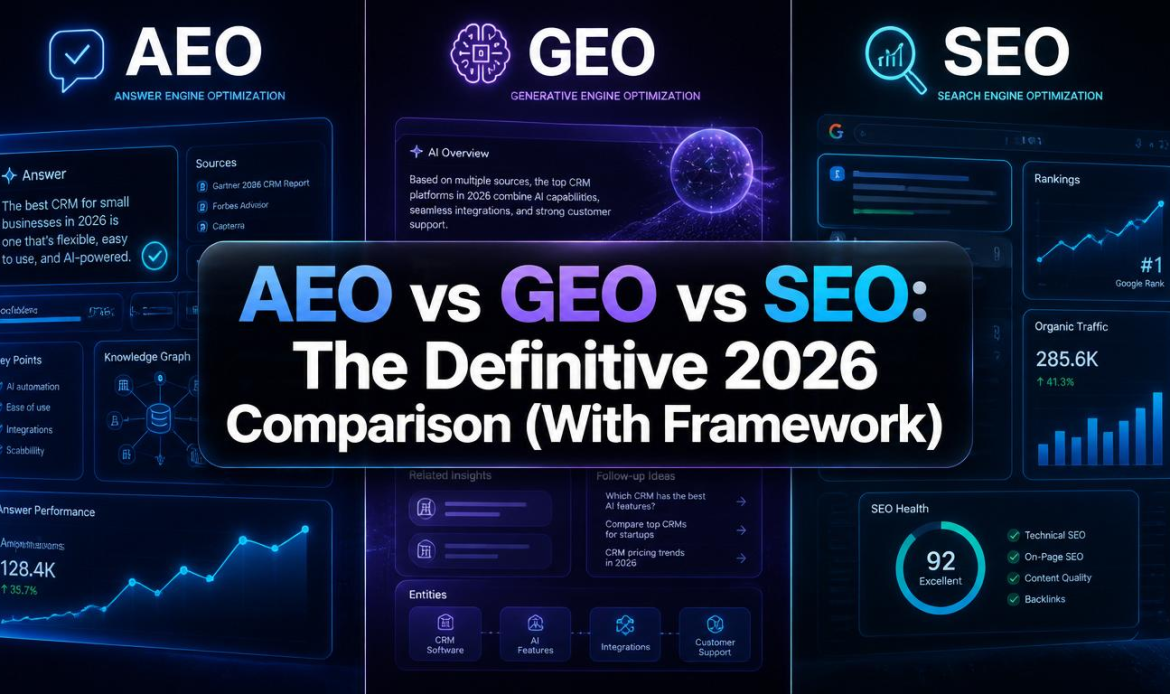
This guide draws the cleanest possible line between the three, then puts them back together into a single framework you can act on. The one line version is worth memorising before we go deeper: SEO optimises for ranking, AEO optimises for selection, and GEO optimises for citation. Each targets a different surface, uses a different success metric, and answers a different question about your content. But all three rest on the same foundation, and in 2026 they are converging fast enough that treating them as separate programmes is itself a mistake.
A note on a fourth acronym you will encounter: AIO (AI Optimization) and LLMO (Large Language Model Optimization) are sometimes added to the list. In practice these are umbrella or subset terms LLMO is best understood as the technical subset of GEO concerned with how language models retrieve and cite content, and AIO is a catch all for optimising across AI surfaces generally. For clarity, this guide focuses on the three that genuinely describe distinct disciplines: SEO, AEO and GEO.
SEO wants position one. AEO wants to be the answer displayed above position one. GEO wants to be the source the AI quotes when it writes the answer in its own words. Same mission visibility three different games.
How We Got Three Acronyms: The Evolution of Search
The three disciplines did not appear at random; each was triggered by a shift in how machines understand and serve information. Seeing that progression makes the differences intuitive rather than arbitrary.
Search began as keyword matching: type a phrase, get a list of pages containing it, and SEO was the craft of being the best matched page. As engines grew better at understanding meaning, they began answering questions directly rather than only listing links the featured snippet, the People Also Ask box, the voice response and AEO emerged to win that answer real estate. Then generative AI arrived, and engines stopped merely displaying an existing answer and started composing new ones by reading and synthesising multiple sources. GEO is the response to that final shift: optimising not to be ranked or even selected, but to be one of the sources the machine trusts enough to weave into an answer it writes itself.
Each generation did not erase the one before it. People still type keywords and click links; engines still surface direct answers; and increasingly they generate synthesised responses. That is precisely why all three disciplines coexist because all three behaviours coexist in how people now search. A brand that optimised only for the first generation is invisible in the third; a brand that chases only the third, ignoring the foundation, never gets read at all.
Strong web design supports all three layers because AI readable pages need clear structure, crawlable architecture, fast loading, schema placement, internal links and conversion paths that make information easier for both humans and machines to understand.
Three Disciplines, One Goal: Visibility
Start with clean definitions, because the confusion almost always begins here. Each is a self contained answer an engine can lift on its own.
Defining SEO
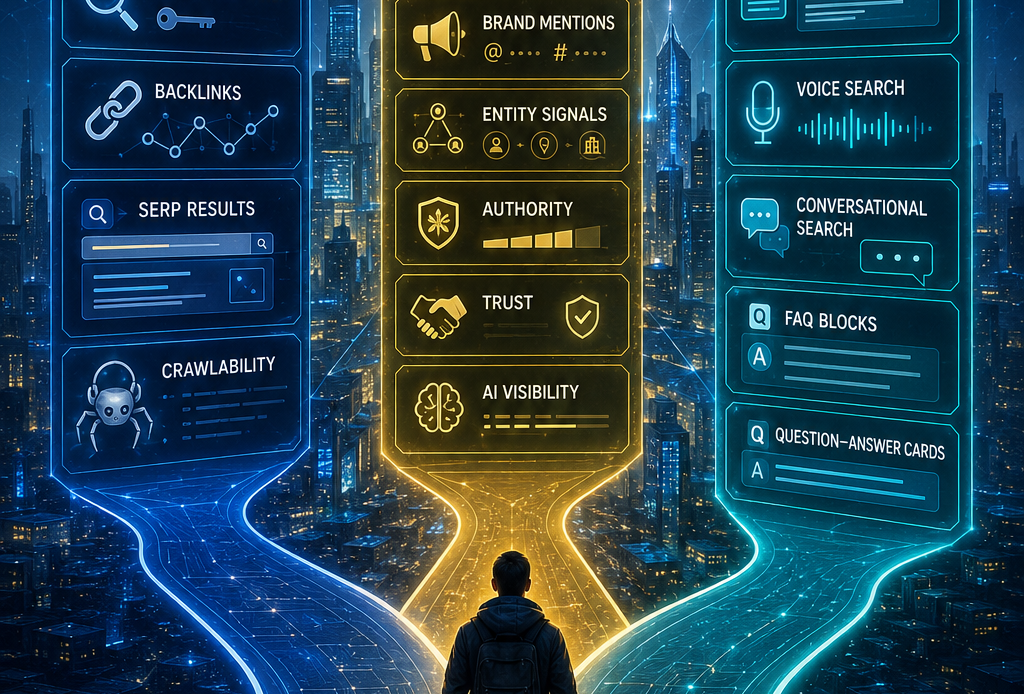
Search Engine Optimization (SEO) is the practice of improving a website’s content, structure and authority so it ranks higher in traditional search engine results and drives organic traffic. It works through keywords, backlinks, technical health and authority signals, and its goal is the click: you appear in a ranked list of links and the user chooses yours. SEO has powered digital visibility for two decades and remains the foundation everything else is built on.
Defining AEO
Answer Engine Optimization (AEO) is the practice of structuring content so it is extracted and displayed as a direct answer in featured snippets, People Also Ask boxes, voice assistant responses and AI answer boxes often without a click. Where SEO competes to be on the menu, AEO competes to be the recommended dish: the single answer shown above the list or spoken aloud. Its defining philosophy is concision and structure, and its success is measured partly in zero click visibility, since users frequently get the complete answer without leaving the results page.
AEO has a recognisable signature on the page. The winning pattern is a question style heading followed immediately by a direct answer of roughly 40–60 words, then expanding detail beneath. For example, a heading like “Do you offer same day service in London?” answered straight away with “Yes we provide same day response across central London, including weekends, with a fixed call out fee” is trivially easy for an answer engine to lift. Burying that answer three paragraphs down, or hedging it across several sentences, forfeits the snippet to a competitor who stated it cleanly. Question led headings, concise answers, and FAQ schema are the core AEO toolkit, and voice assistants in particular draw heavily on pages marked up this way.
Defining GEO
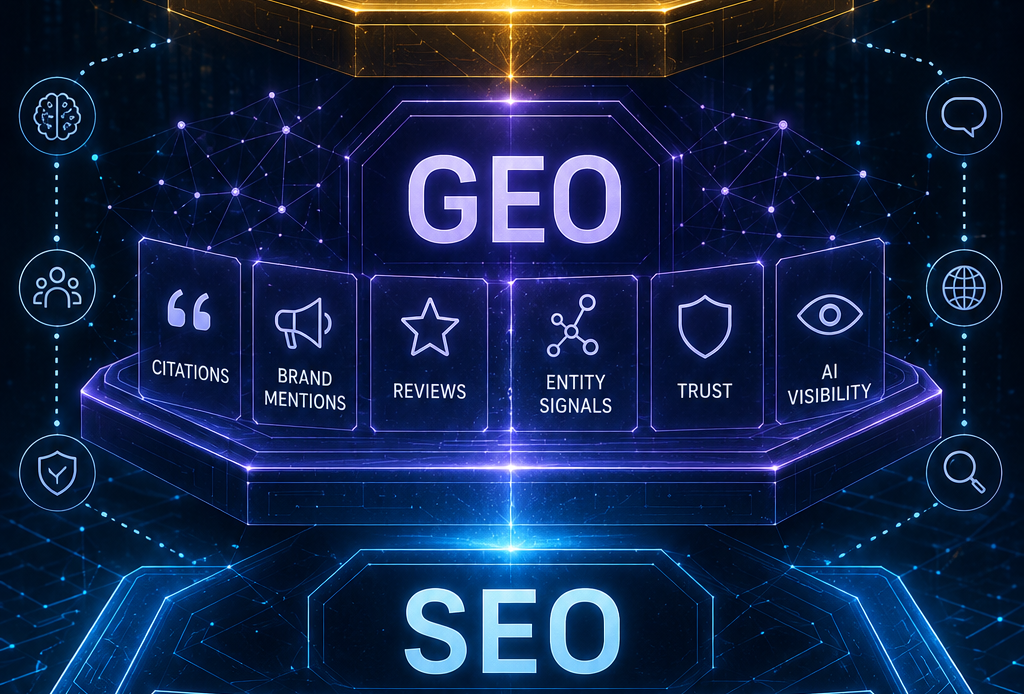
Generative Engine Optimization (GEO) is the practice of structuring content so AI engines cite, quote and synthesize it inside generated answers across ChatGPT, Gemini, Perplexity, Copilot and Claude. Where AEO is about being extracted as a fixed answer, GEO is about being one of the trusted sources an AI draws on while composing an answer in its own words across multiple platforms and multiple machine generated sub queries at once. It works through fact density, structured extractability, entity clarity and off site trust, and the field has academic grounding: the Princeton originated research that named it found GEO techniques can lift visibility in generative engines by up to 40%.
This distinction also belongs inside a broader digital marketing strategy, because SEO, AEO, GEO, organic visibility, brand authority and conversion pathways now work together rather than separately.
The Core Differences
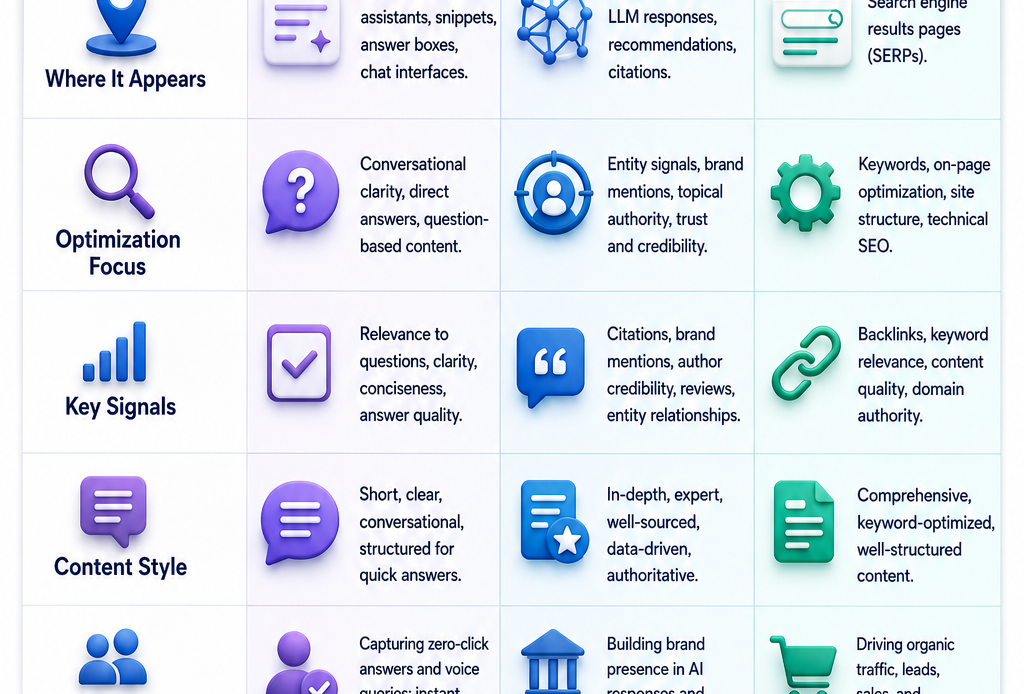
Three dimensions separate them cleanly: the surface they target, the unit they compete for, and the metric that defines success. The table below is the canonical comparison of the extractable data array an engine can lift to answer “what is the difference between SEO, AEO and GEO.”
| Dimension | SEO | AEO | GEO |
|---|---|---|---|
| Goal | Rank | Be selected | Be cited |
| Target surface | Ranked link results | Snippets, voice, answer boxes | AI generated answers |
| Ranking unit | The page / URL | The answer block | The cited claim or passage |
| Core philosophy | Authority & relevance | Concision & structure | Fact density & trust |
| Key signals | Backlinks, keywords, authority | Q&A format, FAQ schema, direct answers | Stats, entity clarity, off site trust |
| Success metric | Rankings, organic clicks | Snippet/voice capture, zero click visibility | Mention rate, citation rate, share of model |
| Click model | Click through | Often zero click | Often zero click + referral |
Target surface: where you are trying to appear
SEO targets the ranked list of organic links. AEO targets the answer real estate that sits above or instead of that list the featured snippet, the People Also Ask box, the voice response, the AI answer box. GEO targets the generated answer itself in conversational AI engines, where there is no list at all, only a synthesised response with a handful of cited sources. As more queries resolve on the answer surface rather than the link list, the centre of gravity shifts from SEO’s territory toward AEO’s and GEO’s.
Ranking unit: what actually competes
In SEO, the competing unit is the page you want your URL ranked. In AEO, it is the answer to block a tight, well structured passage that an engine can lift whole. In GEO, it is the claim or passage the AI quotes while composing its own answer, which may be a single sentence from deep in your page. This is why GEO rewards self contained, fact dense sentences and AEO rewards self contained answer blocks, while SEO can tolerate value spread across a whole page.
Success metric: how you know it worked
SEO is measured in rankings and organic clicks. AEO is measured in snippets and voice captures and, increasingly, in zero click visibility the brand impression you earn even when no one clicks. GEO is measured in mention rate, citation rate and share of model how often, and how prominently, AI engines cite you versus competitors. Measuring GEO with SEO metrics is the most common analytical error in the field: you will conclude it isn’t working when the value is landing inside answers your analytics never sees.
Where the Three Overlap
For all their differences, the three disciplines share more than they divide which is exactly why a single well built page can succeed in all three at once.
Shared technical foundations
Every one of them depends on the same substrate: crawlable, fast, well structured pages; clean structured data; clear entity signals; and genuine authority. Schema markup serves all three; it helps Google display rich results, lets answer engines parse your Q&A for snippets and voice, and gives AI engines a clean signal layer to trust during synthesis. A direct answer first paragraph wins featured snippets (AEO), gets extracted by generative engines (GEO), and improves the user experience that feeds rankings (SEO). The tactics overlap so heavily that most teams do not need three separate playbooks; they need one playbook executed with all three outcomes in mind.
The convergence trend
The relationship between the three has changed completely, and the direction is convergence. AI engines retrieve from the live web and read the top ranking results, so strong SEO directly powers AEO and GEO; one analysis is blunt that if you are not in the top results, the AI is statistically unlikely to read you in the first place. Meanwhile, even with AI search rising, optimising for traditional Google visibility remains essential for brand visibility and relevance, according to 2026 benchmark research. The disciplines are not collapsing into one another, but they are increasingly inseparable in practice: you cannot do excellent GEO on a site with broken SEO foundations, and you cannot capture modern answer surfaces with AEO while ignoring how generative engines cite.
The commercial implication of convergence is that the brands compounding an advantage today started building unified authority E E A T, topical depth and technical infrastructure a year or two ago, not last month. AI visibility is a slow build asset: entity recognition, earned trust and citation frequency accumulate and then reinforce each other. The cost of treating the three as separate, sequential projects is that you keep restarting the clock; the advantage of treating them as one converged effort is that every asset you build does triple duty and the compounding starts sooner. In a category this young, the timing of when you start is often the only variable that separates the cited brands from the invisible ones.
For businesses that receive enquiries by phone after being discovered through AI search, branded search, organic search or answer surfaces, an AI receptionist can help manage missed calls, route questions and support faster follow up.
The Unified Visibility Framework
Here is how to hold all three in one strategy without drowning in acronyms. The guiding formula build for people, structure for machines works in every era and across every framework. The sequencing below is how High 5 Guru operationalises it, and it deliberately resists the temptation to pick a single “winning” acronym, because the winning move is integration, not selection.
The layered model
Think of the three as stacked layers, not competing options. SEO is the foundation layer: it gets you indexed, ranked and eligible to be read at all. AEO is the structure layer: it formats your content so it can be selected as a direct answer. GEO is the synthesis layer: it makes your content fact dense, entity clear and trusted enough to be cited when an AI composes its own answer. You build them bottom up, because each layer depends on the one beneath it but you build them into the same pages, not separate ones.
The layered view also clarifies why a single tactic so often serves multiple layers at once. A question style heading with a 40–60 word direct answer is an AEO move that also feeds GEO extraction and improves the dwell time signals that support SEO. A comparison table is a GEO citation magnet that also wins featured snippets for AEO. Organization and Author schema declare your entity for GEO, qualify you for rich results in SEO, and help answer engines trust your Q&A for AEO. Once you see the overlap, the acronym anxiety dissolves: you are not choosing between three strategies, you are building one set of well structured, trustworthy pages and harvesting three kinds of visibility from them.
For service based and local brands, this unified visibility framework can strengthen local business growth signals and help increase business performance by making the brand more recognisable across search engines, AI engines and trusted third party sources.
When to prioritise each
- Prioritise SEO first if your technical foundations are weak blocked crawlers, slow pages, thin authority. Nothing downstream works until this is solid.
- Lean into AEO if your buyers ask clear, answerable questions how, what, why, when, where and you want to own featured snippets, voice results and answer boxes.
- Push GEO hard if your category’s high intent research increasingly happens inside ChatGPT, Gemini and Perplexity, and being cited there shapes the buyer’s shortlist before they reach your site.
For most B2B and cybersecurity brands in 2026, the honest answer is all three at once SEO maintained, AEO layered onto question led pages, and GEO driving the cornerstone content strategy.
How High5Guru sequences them
In practice we build a single converged programme: every cornerstone page is engineered to rank (SEO), to be selected as an answer (AEO), and to be cited by generative engines (GEO) in the same pass. That means a direct answer in the first 40–60 words after a question style heading, fact density of roughly one verifiable data point per 100 words, FAQ and Article schema, clean entity signals, and a quarterly refresh to stay current. One page, three outcomes because the buyer no longer travels one discovery path, and neither should your content.
This sequencing also supports a long term marketing growth strategy because machine readable trust makes a brand easier to discover, verify, cite and choose across both traditional search and AI generated answers.
The Three Costly Mistakes
Most wasted budget in this area traces to one of three errors. Naming them is the fastest way to avoid them.
Mistake 1: treating AI search like traditional SEO
The biggest error is assuming AI systems rank pages the way Google ranks links. They do not they extract, interpret and generate. Optimising for keyword position when the engine is composing an answer from passages means you win a metric that no longer decides the outcome. Rankings and clicks matter less than being selected and cited, and content built purely for ranking often reads too promotionally and hedged to be lifted as a clean answer.
Mistake 2: chasing GEO while ignoring the foundation
The opposite error is just as costly: rushing to GEO tactics on a site with broken SEO. Because AI engines read the top ranking results, a site that is not crawlable, indexed and reasonably ranked is statistically unlikely to be read at all, no matter how fact dense its content. You cannot skip the foundation and jump to synthesis. GEO sits on top of SEO and AEO; remove the lower layers and the top one has nothing to stand on.
Mistake 3: measuring everything with click metrics
If your only dashboard is rankings and organic traffic, you are blind to most of what AEO and GEO deliver. Much of their value is zero click, a brand impression in a snippet, a citation in an AI answer that never registers as a session. Teams that judge AI search investment by clicks alone conclude it isn’t working and cut it, right as it begins to compound. Add mention rate, citation rate, snippet capture and share of model to the dashboard, or you will manage the programme by the wrong numbers.
Further Reading: High 5 Guru’s New Book
Readers who want a deeper framework for AI SEO, GEO, AEO, LLM visibility, machine readable trust and modern search strategy can explore the High 5 Guru books page. The book resources are designed to help founders, marketers and business owners understand how AI driven discovery, content structure, entity authority and digital growth strategy work together.
Frequently Asked Questions
Written to be lifted directly by AI engines and mapped one to one to FAQPage schema.
What is the difference between SEO, AEO and GEO?
SEO optimises for ranking in a list of links using keywords, backlinks and authority. AEO (Answer Engine Optimization) optimises for selection as a direct answer in featured snippets, voice results and AI answer boxes. GEO (Generative Engine Optimization) optimises for citation inside AI generated answers across ChatGPT, Gemini and Perplexity. All three pursue visibility but target different surfaces and use different success metrics.
Is AEO the same as GEO?
No, though they are often used interchangeably. AEO targets being extracted as a fixed direct answer, a featured snippet, voice response or answer box usually within a search engine. GEO targets being cited and synthesised across multiple generative AI engines as they compose answers in their own words. GEO is broader and assumes multi engine, multi source retrieval; AEO is more about concise, extractable answer blocks.
Should a business do SEO, AEO or GEO first?
Build SEO foundations first, because AI and answer engines read the top ranking results if you are not ranking, you are unlikely to be selected or cited. Layer AEO structure onto question led pages next, then drive GEO through fact dense, entity clear cornerstone content. The disciplines converge, so the strongest approach builds all three into the same pages rather than running them separately.
Which discipline matters most in 2026?
GEO is the fastest growing priority because high intent queries increasingly resolve inside AI answers rather than link lists. However, GEO depends on SEO foundations and shares most tactics with AEO, so the highest performing brands invest in all three as one converged strategy rather than choosing between them. Treating any single acronym as a complete strategy is the common mistake.
What is AIO and LLMO?
AIO (AI Optimization) is an umbrella term for optimising visibility across AI surfaces generally, while LLMO (Large Language Model Optimization) is best understood as the technical subset of GEO focused on how language models retrieve and cite content. In practice both overlap heavily with GEO and AEO and share the same core tactics: structured data, authoritative content and entity clarity.
Can one page be optimised for SEO, AEO and GEO at once?
Yes and it should be. A page that opens with a direct answer after a question style heading, carries fact density and FAQ schema, and has clean entity signals can rank in organic search (SEO), win featured snippets and voice results (AEO), and be cited by generative engines (GEO) simultaneously. The tactics overlap so heavily that most teams need one converged playbook, not three.
Does GEO replace SEO?
No. GEO and SEO are converging, not competing. AI engines retrieve from the live web and favour top ranking, crawlable pages, so strong SEO directly powers AI visibility. Traditional Google visibility also remains important for brand relevance even as AI search grows. The most effective strategy optimises for ranked links and AI citations together within one programme.
How do I measure success across SEO, AEO and GEO?
Use different metrics per layer. SEO: rankings and organic clicks. AEO: featured snippet and voice captures plus zero click visibility. GEO: mention rate, citation rate and share of model across AI engines. Measuring GEO with SEO metrics alone is a common error, because much of GEO’s value lands inside AI answers that traditional analytics never records.
What’s the single most important tactic across all three?
Lead every page with a direct, self contained answer immediately after a clear, question style heading ideally in the first 40–60 words. This wins featured snippets for AEO, gets extracted by generative engines for GEO, and improves the user experience that supports SEO rankings. Front loading the answer is the one move that pays off across all three disciplines.
Is keyword optimization still relevant for AEO and GEO?
Keywords still matter for SEO foundations, but stuffing them hurts in AI contexts. The Princeton GEO research found keyword stuffing performed poorly in generative engines. For AEO and GEO, focus on answering real questions clearly, using natural language, named entities and verifiable data, rather than repeating target phrases. Specificity and structure beat keyword density in answer and generative engines.
Stop running three strategies that fight each other. High 5 Guru builds one converged programme SEO foundation, AEO structure, GEO citation into every page, so your content ranks, gets selected, and gets cited at once. See where you stand with a GEO visibility audit at high5guru.com.
Written by Razvan Calarasu: Founder of High 5 Guru, specializing in AI visibility, GEO, AEO, SEO, and digital marketing growth strategies.
Stop running three strategies that fight each other. High5Guru builds one converged programme SEO foundation, AEO structure, GEO citation into every page, so your content ranks, gets selected, and gets cited at once. See where you stand with a GEO visibility audit at high5guru.com.
Continue Reading
- What Is Generative Engine Optimization (GEO)? The Complete 2026 Definition & Framework
- How to Appear in ChatGPT Search Results: A Step by Step 2026 Guide
- Gemini, Perplexity & ChatGPT: How Each AI Engine Decides Who to Cite
- The GEO Audit: 27 Signals AI Engines Use to Decide If They Can Trust Your Brand
High 5 Guru Machine Readable Trust · www.high5guru.com
