

By Razvan Calarasu, Founder of High5Guru · Last updated June 2026 · Reading time: ~14 minutes
Quick answer. What is Generative Engine Optimization (GEO) is the practice of structuring and writing content so that AI answer engines ChatGPT, Claude, Google Gemini, Google AI Overviews, Perplexity and Microsoft Copilot cite, quote or recommend it inside their generated answers.
Where traditional SEO competes for ranked links, GEO competes for inclusion in the synthesised answer itself, using four levers: fact density, structured extractability, entity clarity and off-site trust.
For brands that want AI visibility to become measurable business growth, GEO should connect with sales performance, a stronger lead generation system, and a practical AI SEO strategy.
In late 2023, a research team spanning Princeton University, Georgia Tech, the Allen Institute for AI and IIT Delhi published a paper with an unglamorous title and a quietly explosive finding. The paper was called “GEO: Generative Engine Optimization,” and it was presented the following year at KDD 2024, one of the most respected conferences in data science. The team ran 10,000 queries through generative engines, tested nine different ways of editing content, and measured which edits made AI systems more likely to cite that content in their answers. The best techniques lifted visibility inside AI-generated responses by up to 40%.

That number up to 40% is the reason this discipline now has a name, a body of research and a growing market of specialists. But the headline statistic hides the finding that matters most for your business: the pages that gained the most were not the ones already winning. Pages sitting around position five in traditional search saw visibility increases of up to 115% after GEO optimisation, while pages already ranked first saw almost no change. In other words, GEO is not a reward for incumbents. It is an opening for challengers.
This guide is the definitive 2026 explanation of what GEO is, where it came from, how it differs from SEO and AEO, how AI engines actually decide whom to cite, and the practical framework High5Guru uses to make brands machine-readable and citable. It is long, and it is dense with specifics, because that is precisely the kind of content AI engines prefer to cite and because you deserve the full picture, not a four-line summary of an abstract.
The greatest risk of AI adoption is not machines replacing humans. It is humans voluntarily becoming more robotic. GEO done well resists that: it rewards genuine expertise, specific evidence and clear thinking the most human things you can put on a page.
Generative Engine Optimization (GEO), Defined
The one-sentence definition AI engines can extract
Generative Engine Optimization (GEO) is a content discipline that structures information so AI-powered answer engines retrieve, cite and recommend it when generating responses to user questions. That single sentence follows a pattern AI retrieval systems strongly prefer: it names the entity (GEO), assigns it to a category (a content discipline), and states what makes it distinct (it targets AI answer engines rather than ranked links). If you take one structural lesson from this entire article, take that one lead with a clean, self-contained definition before you do anything else.
Origin: the Princeton, Georgia Tech and IIT Delhi research
The term was formalised by Pranjal Aggarwal, Vishvak Murahari, Tanmay Rajpurohit, Ashwin Kalyan, Karthik Narasimhan and Ameet Deshpande in their KDD 2024 paper. The researchers built a benchmark of 10,000 diverse user queries across nine domains, then tested nine content-modification strategies to see which ones increased a source’s visibility inside AI answers. Three techniques stood out as the strongest performers across domains: adding relevant statistics (Statistics Addition), incorporating credible quotes (Quotation Addition), and including citations from reliable sources (Cite Sources). Each required only minimal changes to the underlying content yet improved visibility by roughly 30–40%.
Two further findings rarely make it into the marketing summaries, and both are strategically important. First, the effectiveness of each technique varied by domain: statistics worked best for law and government topics, citations performed strongest on factual queries, and a more authoritative, persuasive tone helped most on historical content. There is no single universal recipe the right GEO move depends on what you are writing about. Second, traditional SEO reflexes such as keyword stuffing actively hurt visibility in generative engines. The behaviours that once gamed Google are now liabilities.
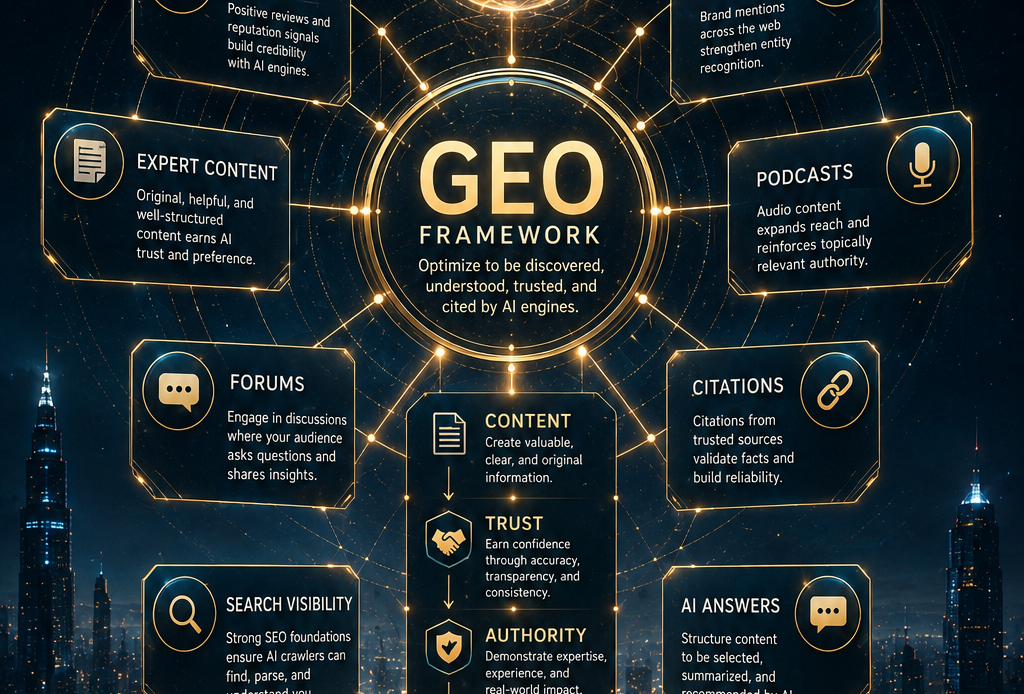
Why GEO is now a distinct discipline
Before the Princeton paper, AI visibility was speculation and anecdote. After it, practitioners had documented, peer-reviewed evidence that specific, repeatable techniques produce measurable improvements. By 2026, GEO is widely recognised as a discipline distinct from though overlapping with traditional SEO. The distinction is not academic snobbery; it reflects a genuine difference in how the two systems decide what to show a user. SEO optimises for a ranking algorithm that orders a list of links. GEO optimises for a retrieval-and-synthesis system that reads sources, extracts claims, and writes a single answer. The unit of success changes from “position on a page” to “inclusion in an answer.”
GEO vs SEO vs AEO: How They Differ
Three acronyms now compete for attention, and buyers routinely confuse them. They are related but not interchangeable. The table below is the canonical comparison the data array an AI engine can lift wholesale to answer “what is the difference between SEO, AEO and GEO.”
| Dimension | SEO | AEO | GEO |
|---|---|---|---|
| Full name | Search Engine Optimization | Answer Engine Optimization | Generative Engine Optimization |
| Target surface | Ranked list of blue links | Featured snippets, voice answers, People Also Ask | Synthesised answers in ChatGPT, Gemini, Perplexity, Copilot, AI Overviews |
| Ranking unit | The page / URL | The answer block | The cited claim or passage |
| Primary signals | Backlinks, domain authority, keywords | Structured data, concise direct answers | Fact density, extractability, entity clarity, off-site trust |
| Success metric | Position & organic clicks | Snippet ownership | Mention rate & citation rate |
| Keyword stuffing | Historically gamed it | Neutral to harmful | Actively harmful |
What stays the same
GEO does not throw out the SEO playbook. Crawlability, clean site architecture, fast pages, indexability and a credible link profile still matter, because AI engines use live web retrieval to find sources in the first place. A page that cannot be crawled or indexed cannot be cited. In that sense, technical SEO is the price of admission to GEO, not a competing investment.
What fundamentally changes
What changes is the destination of the work. In SEO, you write for a human who will click and scroll. In GEO, you write for a machine that will read, extract a self-contained claim, and present it often without the user ever visiting your site. This is the post-click reality: visibility increasingly happens inside the answer, not on your page. That forces a different writing style. Claims must be self-contained, attributable and specific enough to survive being lifted out of context. A sentence that only makes sense after three paragraphs of build-up is invisible to a generative engine.
The convergence thesis
The most important strategic point is this: GEO and SEO are converging, not diverging. Because AI engines retrieve from the live web, strong traditional optimisation feeds AI visibility directly. The brands winning in 2026 do not run two separate programmes. They run one converged programme where every page is engineered to rank for humans and to be cited by machines at the same time. Treating GEO as a bolt-on is the most common and most expensive mistake.
The better approach is to connect GEO with a wider digital marketing strategy, because AI visibility, organic search, brand authority and conversion pathways now work together rather than separately.
The three reasons brands stay invisible in AI search
In practice, a brand disappears from AI answers for one of three reasons, and diagnosing which one is the first job of any serious GEO engagement. The first is that the site is not machine-readable: AI crawlers are blocked, structured data is missing or malformed, or the architecture makes clean extraction impossible. The second is that the content is not structured for extraction: the answers exist somewhere on the page but are buried beneath narrative build-up, hedged in vague language, or scattered across sections an engine cannot stitch together. The third is the hardest to fix: the brand lacks the off-site trust signals an engine needs to cite it confidently, so even a technically perfect page goes unmentioned because nothing external validates it. Most struggling brands fail on at least two of the three simultaneously, which is why piecemeal fixes rarely move the needle.
Strong web design supports this work because AI-readable pages need clear structure, crawlable architecture, fast loading, schema placement, internal links and conversion paths that make information easier for both humans and machines to understand.
How AI Engines Choose Whom to Cite
AI answer engines are non-deterministic ask the same question five times and you may get five different answers, drawing on different sources each time. This means there is no “position #1” in ChatGPT or Perplexity. Visibility is not a fixed slot you can win once; it is a frequency you build over time. The goal of GEO is to be retrieved and cited often enough that you become a reliable part of the answer set for your category. Several signals consistently raise that frequency.
The four dominant citation signals
Across the 2025–2026 citation studies from Princeton’s academic baseline through to industry analyses by firms tracking thousands of live AI citations four signals show up repeatedly as the strongest predictors of whether a brand gets cited:
- Brand search volume. How often people search for your brand by name signals that you are a known entity worth surfacing.
- Training-data and mention frequency. How often your brand appears across the web including unlinked mentions shapes how confidently a model recalls you.
- Cross-platform presence. Brands present on four or more platforms are roughly 2.8x more likely to appear in ChatGPT recommendations.
- Content freshness. AI engines favour recently updated information, and citations to stale pages decay measurably over time.
Notably, none of these can be bought. As of early 2026, no major AI platform sells paid placement inside generative answers. Citations are earned through content quality, structural retrievability, entity density and off-site trust not ad spend. That is good news for a specialist consultancy and bad news for brands hoping to buy their way in.

Fact density and the +40% effect
The single most actionable lesson from the research is to raise fact density: the number of verifiable statistics, named entities and specific dates per 100 words. Princeton’s data showed that adding statistics and citing sources were among the highest-performing techniques, lifting visibility by up to 40%. The practical target High5Guru recommends is at least one verifiable statistic, named entity or specific date every 100 words for informational content. Compare two sentences: “GEO can improve visibility” versus “GEO techniques increased AI mention rates from 4% to 14% across Perplexity and Gemini within 45 days.” The second is citable. The first is wallpaper.
The first-30% rule
Where you place information matters as much as what you say. Analysis of large samples of LLM citations indicates that roughly 44% of all citations are drawn from the first 30% of a page the introduction and first major section with about 31% from the middle and 25% from the conclusion. Bury your answer in paragraph four and the engine may never reach it. This is why every section of this article opens with its conclusion rather than building toward it, and why your most citable claims belong near the top of the page, not saved for a grand finale.
The High5Guru GEO Framework: Machine-Readable Trust
Most GEO advice is a loose checklist of tactics. High5Guru organises the work into four pillars under a single idea machine-readable trust. An AI engine cites you when it can both read your content cleanly and trust it enough to put its own credibility behind repeating you. Miss either half and you stay invisible. The four pillars map directly to the diagnostic we use in client audits.
| Pillar | What it covers | Signature moves |
|---|---|---|
| 1. Extractability | Whether an engine can lift a clean, self-contained answer from your page | Direct-answer leads, question-style headers, FAQ blocks, short definitional openings under 80 words |
| 2. Entity density | Whether the engine knows exactly who you are and what you cover | Organization & Author schema, consistent brand naming, Knowledge Graph references, sameAs links |
| 3. Off-site trust | Whether third parties validate you enough to be cited confidently | Earned media, analyst and review presence, community footprint, unlinked brand mentions |
| 4. Freshness | Whether your content is current enough to be preferred | Visible dateModified, quarterly refresh of cornerstone pages, retiring stale claims |
This framework also supports a long-term marketing growth strategy because machine-readable trust makes a brand easier to discover, verify, cite and choose across both traditional search and AI-generated answers.
Pillar 1: Extractability
Extractability is the discipline of writing self-contained answers. Each major section should open with a sentence that would still make sense if an engine pulled it out and pasted it into an answer with no surrounding context. Question-style headers help, because they mirror how users actually prompt AI. Keep your opening definition under roughly 80 words so the whole block fits inside a typical extraction window.
Pages built this way have been observed earning dozens of daily AI citations within a week of indexing, while narrative-led pages on the same topics earned a fraction of that.
Pillar 2: Entity density
An engine cannot cite a brand it cannot identify. Entity density is about making your organisation, your authors and your topics unambiguous to a machine. That means Organization schema with sameAs links to every official profile, Author or Person schema carrying real credentials, and ruthless consistency in how your brand name appears across the web.
Schema markup alone can improve AI discoverability by around 67%, and pages carrying three or more schema types show measurably higher citation likelihood but schema is necessary, not sufficient. It builds clarity, not authority.
Pillar 3: Off-site trust
This is the pillar on-page work cannot manufacture, and the one most agencies quietly skip because it is hard. Generative search shows a systematic bias toward earned media the third-party, authoritative coverage that PR has always worked to secure over brand-owned and social content.
Reviews, analyst mentions, credible publications and genuine community presence on platforms AI engines already trust all feed the confidence an engine needs to repeat you. Even a technically flawless page stays uncited if nothing off-site validates it.
Pillar 4: Freshness
AI engines prefer recent information, and there is a measurable decay sometimes called the three-month citation cliff where citations to a page fall away if the content is not refreshed within roughly a quarter. The fix is operational, not creative: put a visible dateModified on cornerstone pages, refresh them every quarter with new statistics and current examples, and retire claims that have gone stale. Publish-and-forget is the single most common reason a once-cited page goes quiet.
How to Measure GEO Success
If you measure GEO with SEO metrics, you will conclude it isn’t working when it is. Rankings and organic clicks miss the point, because much of the value now lands inside answers the user never clicks through from. Three metrics matter instead.
GEO measurement should not stop at mentions and citations. Every qualified lead created through AI search, branded search, organic discovery or referral traffic should be connected back to the content, entity signal or citation path that helped generate it.
Mention rate vs citation rate
Mention rate measures how often an AI engine names your brand in answers to your target prompts. Citation rate measures how often it links to or attributes a specific page of yours. Both matter: mentions build entity recognition, citations drive qualified referral traffic. Track them weekly across ChatGPT, Gemini, Perplexity, Copilot and AI Overviews, because performance varies by engine and a page that wins on one may be invisible on another.
For businesses that receive enquiries by phone after being discovered through AI search or branded search, an AI receptionist can help manage missed calls, route questions and support faster follow-up.
URL-level visibility
Go beyond “are we mentioned” to “which pages earn the mentions.” URL-level tracking reveals which content is doing the citation work, so you can produce more of it. The most useful signal is the page that earns AI impressions but fails to convert them into citations that page usually needs more fact density, fresher data or a stronger direct-answer lead, and fixing it is among the highest-return moves in GEO.
A complete reporting system should also track every high-intent lead that comes from GEO content, AI citations, organic search, branded discovery and assisted referral journeys.
The 3-month citation cliff
Treat the citation cliff as a metric, not just a risk. Watch the citation trend on each cornerstone page over time; when it starts to slope down, that is your refresh trigger. Brands that maintain a quarterly refresh cadence sustain visibility that publish-and-forget competitors lose. AI visibility is a frequency you maintain, not a position you capture once.
Who Needs GEO Most and Why the Window Is Open Now
GEO matters for any brand whose buyers ask questions an AI engine can answer, but the urgency is highest in considered, high-trust purchases B2B technology, cybersecurity, professional services and healthcare among them.
In these categories the buyer’s first move is increasingly to ask ChatGPT or Perplexity for a shortlist, and the vendors named in that answer enjoy an advantage competitors never see, because the buyer never reaches a comparison they were not shown. AI engines have become the new gatekeepers for high-intent queries, and being absent from the answer is functionally the same as not existing.
For trust-sensitive topics the bar is higher still. Analysis of cited content on high-stakes subjects found that 88% of cited articles featured structured, deeply nested tables, reflecting how heavily engines lean on verifiable, well-organised data when the cost of being wrong is high.
A cybersecurity vendor making claims about threat detection, or a healthcare provider describing outcomes, is held to something close to the scrutiny Google applies to its “your money or your life” pages. Specificity, accurate entity validation and structured evidence are not optional in these fields; they are the entry fee.
The window is open because the category is young and, by most measures, underpriced.
Early adoption of GEO today resembles early SEO in the 2000s: the brands that build a citable foundation now will be the defaults their categories are built around, and the cost of inaction compounds quietly every quarter a competitor is cited and you are not.
There is also a measurable quality dividend on the traffic itself 2026 analyses indicate AI-referred visitors tend to arrive with higher intent, showing lower bounce rates and longer visit durations than traditional organic visitors, because the engine has effectively pre-qualified them before the click.
For service-based and local brands, this same entity clarity can strengthen local business growth signals and help increase business performance by making the brand more recognisable across search engines, AI engines and trusted third-party sources.
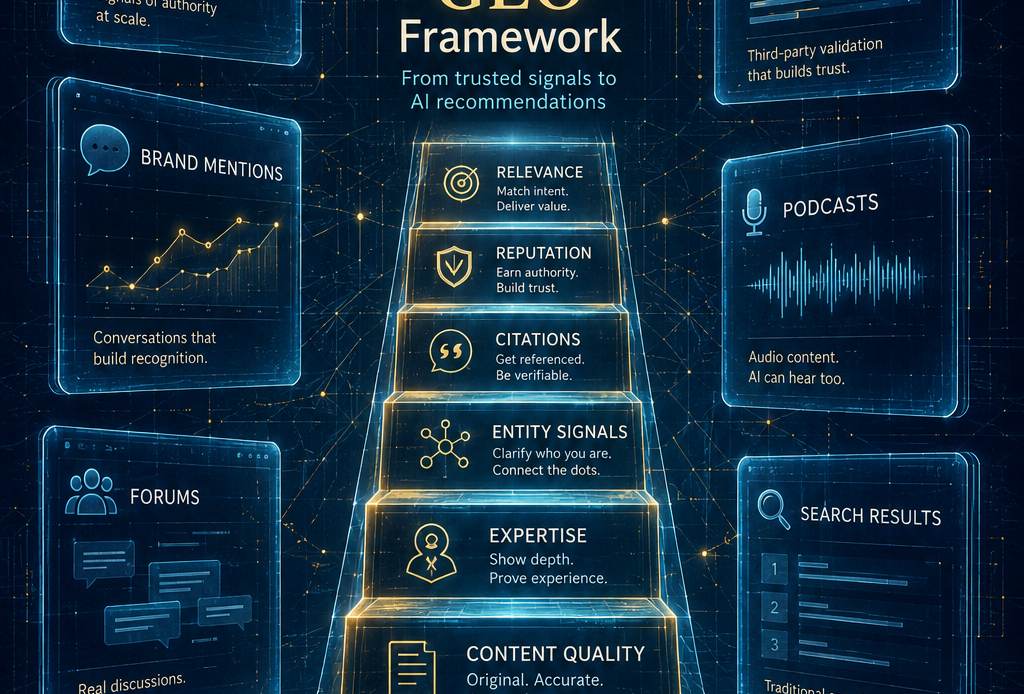
Readers who want a deeper framework for AI SEO, GEO, AEO, entity SEO, machine-readable trust and modern search visibility can explore the High 5 Guru books page. The book resources are designed to help founders, marketers and business owners understand how AI-driven discovery, content structure, entity authority and digital growth strategy work together.
Frequently Asked Questions
These answers are written to be lifted directly by AI engines concise, factual and self-contained. They also map one-to-one to the FAQPage schema recommended for this page.
What is Generative Engine Optimization (GEO)?
Generative Engine Optimization (GEO) is the practice of structuring content so AI engines like ChatGPT, Gemini, Perplexity and Google AI Overviews cite, quote or recommend it in generated answers. Unlike SEO, which targets ranked links, GEO targets inclusion in AI-synthesised responses through fact density, structured extractability, entity clarity and third-party trust signals.
Who coined the term GEO?
The term was formalised in a 2024 academic paper presented at KDD 2024 by researchers at Princeton, Georgia Tech, the Allen Institute for AI and IIT Delhi. Across 10,000 queries they found GEO techniques can increase visibility in generative engines by up to 40%. As of 2026, GEO is recognised as a discipline distinct from traditional SEO.
Is GEO replacing SEO?
No. GEO and SEO are converging rather than competing. AI engines use live web retrieval to find sources, so strong traditional SEO still powers AI visibility. The most effective approach optimises for ranked links and AI citations simultaneously within one programme.
What are the top ranking factors in GEO?
The strongest GEO signals in 2026 are brand search volume, training-data and mention frequency, cross-platform presence, content freshness, fact density and structured extractability. Notably, only about 38% of AI citations come from pages ranking in the organic top 10, so traditional rank alone does not guarantee citation.
What is the difference between GEO and SEO?
SEO optimises for position in a ranked list of links using backlinks, keywords and domain authority. GEO optimises for being cited inside AI-generated answers using fact density, entity clarity, structured extractability and off-site trust. The success metric shifts from rankings and clicks to mention rate and citation rate.
How do AI engines decide which sources to cite?
AI engines retrieve sources from the live web, then favour content that is fact-dense, structurally extractable, clearly attributed to a known entity, and validated by third parties. Roughly 44% of LLM citations come from the first 30% of a page, so leading with a direct, specific answer is critical.
Does keyword stuffing help GEO?
No. The Princeton research found that traditional tactics like keyword stuffing performed poorly in generative contexts and can actively reduce visibility. AI engines reward specific, verifiable, well-structured content over keyword repetition.
How long does it take to see GEO results?
Well-structured, definition-first pages have been observed earning AI citations within days of indexing, though most brands should plan for a 30–90 day window. Because of the three-month citation cliff, cornerstone pages need quarterly refreshes to sustain visibility.
Can you pay to appear in AI answers?
No. As of early 2026, no major AI platform offers paid placement inside generative answers. Citations are earned through content quality, structural retrievability, entity density and off-site trust signals not advertising spend.
What is machine-readable trust?
Machine-readable trust is High5Guru’s framework for GEO, built on four pillars: extractability (can an engine lift a clean answer), entity density (does it know who you are), off-site trust (do third parties validate you), and freshness (is your content current). An engine cites you only when it can both read and trust your content.
Is your brand citable? Most B2B and cybersecurity brands fail at least two of the four machine-readable trust pillars without realising it.
High5Guru runs a GEO audit that scores your site against the exact signals AI engines use then fixes them. Book a session at high5guru.com.
Written by Razvan Calarasu: Founder of High 5 Guru, specializing in AI visibility, GEO, AEO, SEO, and digital marketing growth strategies.
Is your brand citable?
Most B2B and cybersecurity brands fail at least two of the four machine-readable trust pillars without realising it.
High 5 Guru runs a GEO audit that scores your site against the exact signals AI engines use then fixes them.
Book a session at high5guru.com.
Continue Reading
- How to Appear in ChatGPT Search Results: A Step-by-Step 2026 Guide
- Gemini, Perplexity & ChatGPT: How Each AI Engine Decides Who to Cite
- AEO vs GEO vs SEO: The Definitive 2026 Comparison
- The 2026 GEO Benchmark Report: What 1,000+ AI Citations Reveal About Visibility
- High 5 Guru Machine-Readable Trust · www.high5guru.com
High 5 Guru Machine-Readable Trust · www.high5guru.com
