

By Razvan Calarasu, Founder of High5Guru · Last updated June 2026 · Reading time: ~15 minutes
Quick answer. How to Appear in ChatGPT Search Results, your page must clear two gates: discoverability and selectability. First, get indexed by Bing and allow OpenAI’s crawler (OAI SearchBot) so ChatGPT can find you. Then make your content survive the cut lead with a direct answer in the opening, raise fact density to roughly one verifiable statistic or named entity per 100 words, add FAQ and Article schema, serve fast static HTML, keep it fresh, and earn third party mentions. ChatGPT cites only about 15% of the pages it retrieves, so being found is not enough; you must be the most extractable, trustworthy source for the machine generated sub queries it actually runs.
For brands that want ChatGPT visibility to become measurable business growth, this process should connect with sales performance, a stronger lead generation system, and a practical AI SEO strategy.
Here is the uncomfortable truth most businesses discover too late: you can rank number one on Google and be completely invisible inside ChatGPT. The two systems do not share an index, do not run the same query, and do not reward the same content. A page that dominates Google can be absent from every answer ChatGPT gives about your category, because ChatGPT never searched Google and never typed the query you optimized for.

In April 2026, Search Engine Land tested the prompt “What are the best hotels in New York City?” across 68 ChatGPT iterations and pulled out 25 unique machine generated sub queries. One hotel, The Fifth Avenue Hotel, appeared in 13 of the responses. A rival that dominated Google for the same topic appeared in just one. The difference was not Google rank. It was that The Fifth Avenue won on Bing, and ChatGPT runs on Bing. That single case captures the entire challenge of this guide.
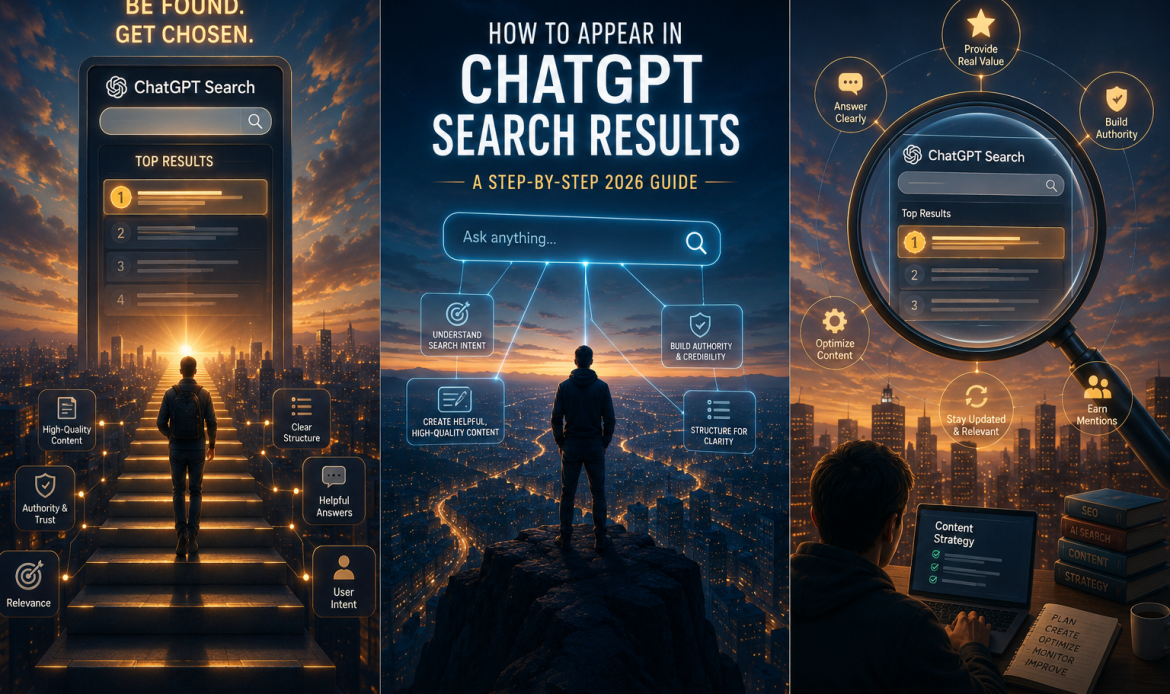
This is a complete, step by step method for getting your brand cited in ChatGPT search results in 2026. It is grounded in how ChatGPT actually retrieves and selects sources query fan out, Bing indexation, retrieval augmented generation and passage selection and it ends with the seven concrete steps High5Guru uses with clients, the technical checks that block most brands, and an FAQ engineered to be cited verbatim. Follow it in order; the early steps are prerequisites that make the later ones work.
Most ChatGPT optimization advice obsesses over being found. The harder problem is being chosen. ChatGPT cites only about 15% of the pages it retrieves; the other 85% are read, judged and discarded. Your real competition is not invisibility. It is the cut.
How ChatGPT Search Actually Retrieves Sources
Before the steps, you need the mechanism, because every tactic that follows is downstream of it. ChatGPT does not run one search and read the top result. It runs a multi stage retrieval augmented generation (RAG) pipeline, and understanding the four stages is what separates informed GEO strategy from guesswork.

Stage 1: the search or answer decision
ChatGPT does not always search the web. For questions it can answer from its training data, it often answers from memory and cites nothing live. Browsing is triggered by signals that the model needs current or specific information: a year in the prompt (“in 2026”), a price constraint (“under £500”), a comparison structure (“X vs Y”), recent events, or the user explicitly enabling search. A 2026 study found prompts containing a year, a price, or a comparison triggered web search 100% of the time. The practical implication: your citation strategy should target the topics where live retrieval is common current statistics, recent tool comparisons, specific how to guidance and anything time sensitive.
Stage 2: query fan out
When ChatGPT does search, it decomposes the user’s prompt into multiple atomic sub queries and runs each against Bing simultaneously, a process Google named query fan out. Recent analysis found newer models sending on the order of 8.5 sub queries per prompt. Crucially, an analysis of 4,700 ChatGPT responses found that around 95% of these fan out queries have effectively zero human search volume. You are competing in searches no human would ever type. This is why ranking for your one obvious keyword is a weak proxy for ChatGPT visibility: you must match the many machine generated sub queries that actually retrieve the sources.
The same analysis found that around 89.6% of prompts triggered follow up searches, meaning the fan out is the rule, not the exception. The earlier hotels example shows why this is decisive: across 68 runs of one prompt, the winning hotel was the one that ranked on Bing for the specific sub queries the model generated, while a rival that owned Google for the topic surfaced once. You cannot see these sub queries by guessing you discover them, then build content that answers each as a self contained block.
Stage 3: retrieval and chunking
For each sub query, ChatGPT pulls the top ranking Bing pages, then breaks them into chunks and reads them in passages rather than whole. Static HTML with clean structure parses reliably; one 2026 dataset put AI parsing success for static HTML with schema at 94%, versus just 23% for JavaScript rendered content. If your content only assembles in the browser via JavaScript, the retriever may see almost nothing. Page speed matters too: pages with very fast first contentful paint averaged several times more citations than slow loading pages, suggesting the retrieval crawler enforces a timeout that quietly penalises sluggish sites.
Strong web design supports this work because AI readable pages need clear structure, crawlable architecture, fast loading, schema placement, internal links and conversion paths that make information easier for both humans and machines to understand.
Stage 4: passage selection the 15% cut
This is where most brands lose. After retrieving and chunking candidate pages, ChatGPT scores passages and selects which to quote or paraphrase. An AirOps study analysing 548,534 pages across 15,000 prompts found ChatGPT cites only about 15% of the pages it retrieves; the other 85% are evaluated and discarded. Selection factors include domain authority, freshness, entity density and passage level relevance. So there are two separate problems to solve: discoverability (entering the retrieval pool) and selectability (surviving the cut). The seven step method below solves both, in order.
The 7 Step ChatGPT Visibility Method
These seven steps map directly to the HowTo schema recommended for this page. Steps 1 and 2 are discoverability. Steps 3 through 7 are selectable the harder, higher value half.
Step 1: Get indexed by Bing and allow OpenAI’s crawler
Nothing else matters until this is done. ChatGPT Search retrieves primarily from Bing’s index and supplements it with its own crawler, OAI SearchBot. Two prerequisites follow. First, your important URLs must be indexed in Bing, open Bing Webmaster Tools, submit your sitemap directly, and confirm your key pages are present. A page ranked first on Google but missing from Bing cannot be cited by ChatGPT. Second, your robots.txt must not block OAI SearchBot; if it does, you will be absent even if Bing has you. To get fresh content into the pool quickly, adopt the IndexNow protocol, which notifies Bing the moment a page changes rather than waiting for a recrawl. This step takes roughly fifteen minutes and unblocks citation potential most sites leave on the table.
Step 2: Match the sub queries, not just the headline keyword
Because of query fan out, you optimise for a cluster of related sub questions, not a single phrase. Take your target topic and brainstorm the atomic questions a machine would generate from its definitions, comparisons, prices, “best for X” variants, and step by step how tos. Build a prompt map of these sub queries and ensure your content (across one page or a tight cluster) answers each one in a self contained block. The Bing AI Performance report, launched in public preview on 10 February 2026 inside Bing Webmaster Tools, shows the exact query phrases the AI used to retrieve each cited page and use it to discover which real sub queries are surfacing you and which you are missing.
Step 3: Lead with a direct, extractable answer
ChatGPT reads in passages, so each section must open with a self contained answer that survives being lifted out of context. Put your core answer in the first paragraph, use question style H2s that mirror how users prompt, and keep definitional openings under about 80 words so the whole block fits a typical extraction window. Roughly 44% of LLM citations are drawn from the first 30% of a page, so a great answer buried in paragraph four may never be reached. Narrative build up is the enemy of extraction: state the conclusion, then support it.
Step 4: Engineer fact density
ChatGPT preferentially cites content that gives it something specific to reference statistics, original data, named expert claims rather than text it can only paraphrase. The Princeton GEO research found that adding statistics and citing sources were among the highest impact techniques, lifting visibility by up to 40%. Aim for at least one verifiable statistic, named entity or specific date per 100 words. Replace every vague assertion with a number: not “this improves visibility” but “this raised mention rate from 4% to 14% in 45 days.” Specific, sourced and dated content is what survives the 15% cut.
Step 5: Add FAQ and Article schema, and serve clean HTML
Structured data is how you hand the retriever a clean, labelled version of your content. Implement Article (or BlogPosting) schema with author and dateModified, and FAQPage schema mapping each question to its answer. Schema markup can improve AI discoverability by around 67%, and pages carrying three or more schema types show measurably higher citation likelihood. Equally important is the delivery: serve your core content as static, server rendered HTML, not JavaScript that assembles client side, given the gap between 94% and 23% parsing success. Keep the page fast sub second first contentful paint correlates with markedly more citations.
Step 6: Build cross platform presence and earn third party mentions
Selection weighs domain authority and entity recognition, and neither lives only on your own site. Brands present on four or more platforms are roughly 2.8x more likely to appear in ChatGPT recommendations, and generative search shows a systematic bias toward earned media over brand owned content. Pursue credible publications, analyst and review presence, and genuine community footprint on platforms ChatGPT already trusts. Consistent unlinked brand mentions count too, because they reinforce how confidently the model recognises and recalls your brand as an entity. This is the slowest step and the one competitors cannot copy overnight which is exactly why it is worth doing.
This step also supports a wider digital marketing strategy, because AI visibility, organic search, brand authority and conversion pathways now work together rather than separately.
Step 7: Monitor, refresh and iterate
ChatGPT favours fresh information, and citations decay the three month citation cliff describes how mentions to a page fall away if it is not refreshed within roughly a quarter. Track your citation and mention rate weekly, use the Bing AI Performance report to see which URLs and sub queries earn citations, and refresh cornerstone pages quarterly with new statistics and current examples. The highest return move is finding a page that gets retrieved but not cited. It entered the pool and failed the cut then raising its fact density, freshness and direct answer lead until it survived.
This monitoring process can also support a long term marketing growth strategy because machine readable trust makes a brand easier to discover, verify, cite and choose across both traditional search and AI generated answers.
What ChatGPT Actually Likes to Cite
Two stages of the pipeline reward content formats most brands underuse, so it is worth being concrete about what survives the cut.
Self contained, modular blocks beat sprawling guides
Because retrieval works in chunks, ChatGPT rewards modular content: short, labelled sections that each answer one question completely, rather than a single sprawling “ultimate guide” the reader must scroll through. The retriever is looking to harvest a clean micro answer it can patch into its response, not to read your page top to bottom. In practice this means more question style H2s, more self contained paragraphs, and fewer sentences that depend on three paragraphs of prior context to make sense. A useful test: copy any single paragraph out of your page and read it cold. If it still delivers a complete, accurate answer, it is extractable. If it dangles referring to “this approach” or “as mentioned above” it will struggle to be cited.
Tables, statistics and named sources do the heavy lifting
ChatGPT relies on structured data arrays it can read and compare quickly, which is why comparison tables, clearly formatted statistics and named expert claims punch above their weight. Give the engine something to reference rather than merely paraphrase: a dated figure, a named study, a labelled comparison. This also explains why citing other credible sources within your own content paradoxically increases your own citation likelihood; it signals thoroughness and gives the retriever verifiable anchors. The brands that win the 15% cut are rarely the ones with the most words; they are the ones with the most extractable evidence per page.
The 7 Steps at a Glance
This table is the canonical, extractable summary of the method the data array an engine can lift to answer “how do I appear in ChatGPT.”
| Step | Action | Why it matters |
|---|---|---|
| 1 | Index in Bing; allow OAI SearchBot | ChatGPT retrieves from Bing’s index; blocked crawlers mean zero citations |
| 2 | Map and match the fan out sub queries | ~95% of fan out queries have no human search volume; you must match them |
| 3 | Lead with a direct answer | ~44% of LLM citations come from the first 30% of the page |
| 4 | Engineer fact density | Statistics and citations lifted visibility up to 40% in Princeton testing |
| 5 | Add schema; serve fast static HTML | Schema lifts discoverability ~67%; static HTML parses at 94% vs 23% for JS |
| 6 | Build cross platform presence & earned media | 4+ platforms = ~2.8x more likely to be recommended by ChatGPT |
| 7 | Monitor, refresh, iterate | Citations decay within ~3 months without a refresh |
ChatGPT Specific Optimisation Tactics
Beyond the universal method, three ChatGPT specific realities deserve their own attention because they catch out brands who assume ChatGPT behaves like Google.
The Bing dependency most SEOs ignore
Citations match Bing’s top results around 87% of the time, with most appearing in Bing positions one through ten and a long tail through twenty. By contrast, ChatGPT citations matched Google’s results only about 56% of the time, with a median citation rank around 17. The lesson is blunt: monitor Bing rankings, not just Google. Most marketing teams have never opened Bing Webmaster Tools, which means they are flying blind on the index that actually feeds ChatGPT. Verifying your property and reading the AI Performance report is among the highest leverage hours you can spend.
Training mode vs browsing mode
ChatGPT has two distinct modes with different rules. Training data mode draws on the base model’s knowledge up to its cutoff and is not retroactively optimisable you cannot edit your way into a model that has already been trained. Browsing mode performs live Bing indexed retrieval, and it is the only one current optimisation can influence. So focus your GEO effort on prompts that reliably trigger browsing: current data, recent comparisons, specific guidance and time sensitive topics. Trying to “optimise for” training mode is wasted effort; optimising for browsing mode is where citations are won today.
Why well ranked brands still stay invisible
If a brand ranks well yet never appears in ChatGPT, the cause is almost always one of four things: it is not in Bing’s index, it blocks OAI SearchBot, its content is JavaScript rendered and unparseable, or its answers are buried in narrative rather than front loaded and self contained. Each is fixable, and fixing them in order indexation, crawler access, rendering, structure is faster and cheaper than producing more content. More content on an unindexed, unparseable site simply produces more invisibility.
For service based and local brands, fixing these issues can strengthen local business growth signals and help increase business performance by making the brand more recognisable across search engines, AI engines and trusted third party sources.
Measuring Your ChatGPT Citation Rate
You cannot improve what you do not measure, and ChatGPT visibility needs its own metrics distinct from rankings and clicks.
The tools that show you the truth
Start with the free, first party source: the Bing Webmaster Tools AI Performance report, which since February 2026 shows total citation counts across Microsoft Copilot and Bing AI summaries, page level citations by URL, the exact query phrases the AI used to retrieve each cited page, and a trend over time. Pair it with dedicated AI visibility trackers that prompt ChatGPT across your target questions and record how often you are mentioned and cited. The combination tells you both what the index sees and what the answer actually says.
For businesses that receive enquiries by phone after being discovered through AI search or branded search, an AI receptionist can help manage missed calls, route questions and support faster follow up.
The two numbers to watch
Track mention rate how often ChatGPT names your brand across your target prompts and citation rate how often it links to or attributes a specific page. Mentions build entity recognition; citations drive qualified referral traffic, and AI referred visitors tend to arrive pre qualified, with lower bounce rates and longer sessions than typical organic visitors. Set a benchmark in your first month, then aim to move both numbers quarter over quarter. Remember there is no fixed “position one” in ChatGPT; success is frequency, built and maintained over time, not a slot you capture once.
A complete reporting system should also track every high intent lead that comes from GEO content, AI citations, organic search, branded discovery and assisted referral journeys.
Further Reading: High 5 Guru’s New Book
Readers who want a deeper framework for AI SEO, GEO, AEO, ChatGPT visibility, machine readable trust and modern search strategy can explore the High 5 Guru books page. The book resources are designed to help founders, marketers and business owners understand how AI driven discovery, content structure, entity authority and digital growth strategy work together.

Frequently Asked Questions
Written to be lifted directly by AI engines and mapped one to one to FAQPage schema.
How do I get my website to appear in ChatGPT?
To appear in ChatGPT, first make sure your pages are indexed by Bing and that your robots.txt allows OpenAI’s OAI SearchBot, since ChatGPT retrieves primarily from Bing’s index. Then make your content selectable: lead each page with a direct answer, raise fact density to about one statistic or named entity per 100 words, add FAQ and Article schema, serve fast static HTML, and earn third party mentions. ChatGPT cites only about 15% of retrieved pages, so being found is necessary but not sufficient.
Does ChatGPT use Google or Bing for search?
ChatGPT Search retrieves primarily from Microsoft Bing’s index, not Google, and supplements it with its own crawler, OAI SearchBot. A page that ranks first on Google but is missing from Bing’s index cannot be cited by ChatGPT. Citations match Bing’s top results roughly 87% of the time, versus about 56% for Google, so Bing indexing and rankings are the priority for ChatGPT visibility.
What is query fan out in ChatGPT?
Query fan out is when ChatGPT decomposes a single prompt into multiple atomic sub queries, runs each against Bing, and synthesises one answer from the retrieved pages. Newer models generate around 8.5 sub queries per prompt, and roughly 95% of those sub queries have effectively zero human search volume so optimising for one headline keyword is a weak proxy for ChatGPT visibility.
Why isn’t my site showing up in ChatGPT?
Brands usually stay invisible in ChatGPT for one of four reasons: the site is not in Bing’s index, it blocks OAI SearchBot, its content is JavaScript rendered and hard to parse, or its answers are buried in narrative rather than front loaded. Fixing them in order indexation, crawler access, rendering, structure is faster than producing more content.
How long does it take to get cited by ChatGPT?
Content can appear in ChatGPT answers within hours of being indexed by Bing if it is crawlable, well structured and relevant, though most brands should plan for a 30–90 day window to build consistent citation frequency. Because citations decay over roughly three months, cornerstone pages need quarterly refreshes to sustain visibility.
Does ChatGPT always search the web?
No. ChatGPT answers many questions from its training data without searching. It triggers live browsing for current, specific or location based queries prompts containing a year, a price constraint, or a comparison structure trigger search almost every time. Only browsing mode is influenced by current optimisation, so GEO effort should target topics where live retrieval is common.
What percentage of retrieved pages does ChatGPT actually cite?
ChatGPT cites only about 15% of the pages it retrieves. A 2026 analysis of over 548,000 pages across 15,000 prompts found the other 85% are pulled in, evaluated and discarded. This is why selectability fact density, freshness, schema and clean HTML matters as much as discoverability.
Does page speed affect ChatGPT citations?
Yes. Pages with very fast first contentful paint have been observed earning several times more citations than slow loading pages, suggesting ChatGPT’s retrieval crawler enforces a timeout that penalises slow sites. JavaScript rendered content is also a problem: static HTML with schema parses at around 94% success versus about 23% for client side JavaScript.
How do I track my ChatGPT visibility?
Use the Bing Webmaster Tools AI Performance report, available since February 2026, which shows citation counts, page level citations by URL, and the exact query phrases the AI used to retrieve each cited page. Pair it with an AI visibility tracker that prompts ChatGPT across your target questions and records your mention rate and citation rate over time.
Can I pay to appear in ChatGPT search results?
No. As of 2026, OpenAI does not sell paid placement inside ChatGPT’s generated answers. Citations are earned through Bing indexation, content quality, structural extractability, entity recognition and off site trust signals not advertising spend.
Invisible in ChatGPT? Most brands fail Step 1 without knowing it is unindexed in Bing, blocking OAI SearchBot, or serving content ChatGPT can’t parse. High5Guru runs a ChatGPT readiness audit covering indexation, crawler access, schema and content structure, then fixes what’s blocking your citations. Book at high5guru.com.
Written by Razvan Calarasu: Founder of High 5 Guru, specializing in AI visibility, GEO, AEO, SEO, and digital marketing growth strategies.
Invisible in ChatGPT? Most brands fail Step 1 without knowing it is unindexed in Bing, blocking OAI SearchBot, or serving content ChatGPT can’t parse. High5Guru runs a ChatGPT readiness audit covering indexation, crawler access, schema and content structure, then fixes what’s blocking your citations. Book at high5guru.com.
Continue Reading:
- What Is Generative Engine Optimization (GEO)? The Complete 2026 Definition & Framework
- Gemini, Perplexity & ChatGPT: How Each AI Engine Decides Who to Cite
- The GEO Audit: 27 Signals AI Engines Use to Decide If They Can Trust Your Brand
- The 2026 GEO Benchmark Report: What 1,000+ AI Citations Reveal About Visibility
High 5 Guru Machine Readable Trust · www.high5guru.com
